Removing asbestos pipes and fibre-cement water tanks
Fibre-cement water tanks, downpipes, chimney flues and buried asbestos pipes removed safely, with the surrounding work handled by us.
Province of Málaga · in English
Corrugated uralita roofs, fibre-cement water tanks and old asbestos pipes turn up in villas, fincas, warehouses and apartment blocks all over the province of Málaga. We organise their removal for owners and buyers who are often not in Spain: the asbestos work itself is done by a RERA-registered subcontractor, and we take care of everything around it.

In short
Retirada de Uralita Málaga coordinates uralita and asbestos removal throughout the province of Málaga for foreign owners, buyers and communities of owners. The asbestos-containing material is removed by a company registered in the RERA, working as our subcontractor under its own approved work plan; we coordinate that phase and carry out the rest of the demolition, the rubble removal and the clean-up of the site.
Each page explains one type of job: where the material usually sits, how the removal is split between the RERA-registered company and our own team, and what you need to prepare.
Fibre-cement water tanks, downpipes, chimney flues and buried asbestos pipes removed safely, with the surrounding work handled by us.
Uralita roofs and cladding removed from warehouses, workshops and farm buildings, followed by demolition or re-roofing preparation.
Shared uralita roofs, tanks and downpipes in apartment blocks: information for the owners' meeting and a coordinated removal.
Uralita roofs on villas, garages, carports and porches removed by a RERA-registered subcontractor and coordinated with the new roof.
All the uralita on a villa, apartment or finca removed in one coordinated job, with a single English-speaking contact and photos.
Asbestos removal and disposal ahead of a demolition: a RERA-registered subcontractor first, then our demolition and waste sorting.
In Spain, «uralita» is the everyday word for fibre-cement – grey corrugated sheets, tanks and pipes made of cement reinforced with fibres. Uralita was the name of a Spanish manufacturer, and the brand became the generic term, much as «Hoover» did in Britain. The products that matter are the older ones, made as asbestos cement (fibrocemento con amianto), in which asbestos fibres were mixed into the cement.
You will find it on the roofs of country houses, garages, carports and porches, as water tanks on flat roofs, as downpipes and chimney flues on façades, as buried water mains on rural plots and as the roof of almost every older farm building or small warehouse. Many buyers only discover it when a surveyor, a builder or a neighbour points it out.
The concern is not the grey sheet sitting quietly on a roof; it is the fibres released when the material is broken, cut, drilled, sanded, pressure-washed or simply left to crumble. That is why the removal is regulated and why it is not a weekend job. If you are not sure what you are looking at, our guide on how to recognise uralita shows the typical shapes, markings and places to check – without touching anything.
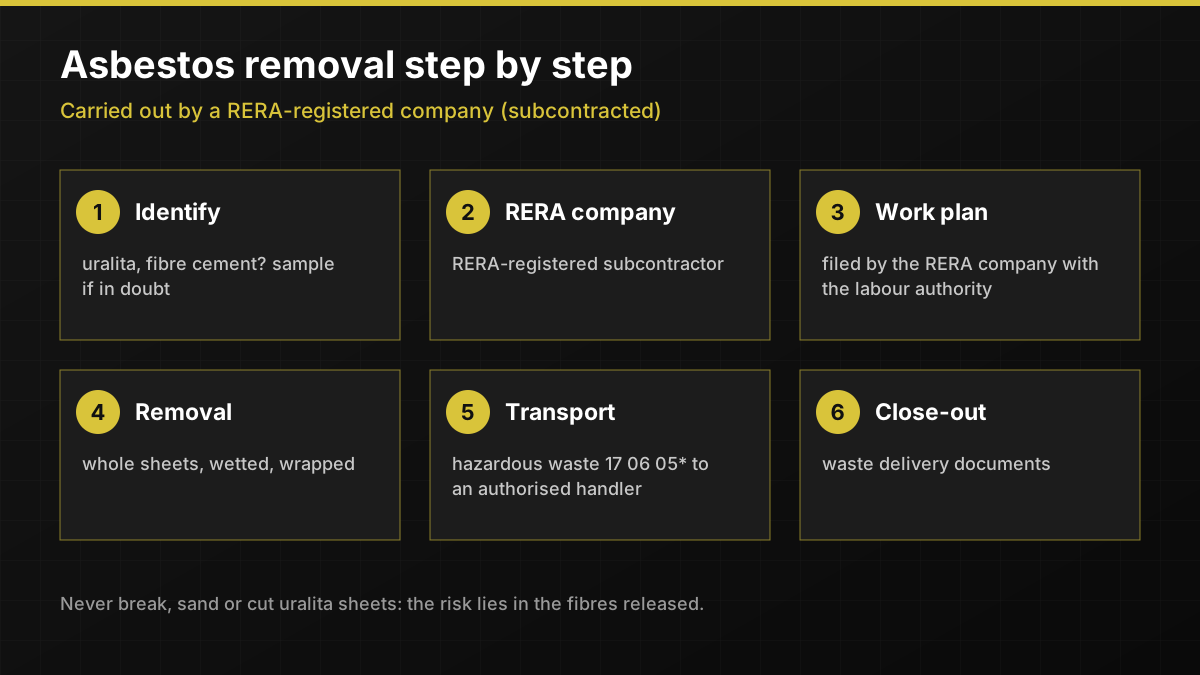
Only a company registered in the RERA (Registro de Empresas con Riesgo por Amianto) may demolish or remove materials that contain asbestos, and it must do so under a work plan approved by the labour authority of the province where the job takes place. The rules are set by Real Decreto 847/2026, in force since late October 2026, which replaced Real Decreto 396/2006 – so older articles quoting the 2006 decree are now out of date.
In Andalusia the RERA is kept by the Junta de Andalucía, and work plans for a job in Málaga are approved by the provincial labour authority (the Delegación Territorial of the regional labour department). The start of the work is notified in advance. A general builder, a handyman or a gardener cannot legally take your uralita roof down, however careful they promise to be.
Our guides on the RERA register and on the asbestos work plan and who approves it go into detail, and the post on red flags with contractors who lack RERA registration lists the warning signs we hear about most often.
Most uralita jobs are not only about asbestos. A garage roof comes off and the garage itself has to go; a water tank is removed and the concrete plinth under it must be broken out; a warehouse loses its roof and then its walls. We split the work so that each part is done by the right people and you deal with a single contact throughout.
When two companies work on the same site, Spanish health and safety rules (Real Decreto 1627/1997) expect the promotor – usually you, as owner – to appoint a safety coordinator during the works. In practice your architect or technical adviser sorts this out, and we fit our dates around theirs and the subcontractor's.
The same material appears in very different situations, so each type of job has its own page with the details that matter for it:
| Element | Where it usually is | Read more |
|---|---|---|
| Corrugated roof sheets | Villas, garages, carports, porches, pergolas, sheds | Uralita roof removal |
| Downpipes, tanks, flues, buried pipes | Flat roofs, façades, chimneys, rural plots | Asbestos pipes and tanks |
| Large roofs and wall cladding | Warehouses, farm buildings, workshops, stables | Asbestos in warehouses |
| Shared roofs, tanks and shafts | Apartment blocks and urbanisations | Asbestos in communities |
| Everything uralita on one property | Older villas, fincas and apartments | Uralita removal |
| Asbestos found as part of a demolition | Any building being knocked down or gutted | Asbestos removal and disposal |
If the property is going to be demolished completely afterwards, the house or villa itself is handled through our sister site Demoliciones Málaga, with the asbestos phase scheduled first.
A large share of the uralita on the Costa del Sol and inland sits on properties whose owners live in the United Kingdom, Ireland, Scandinavia, Germany or the Netherlands. You do not need to fly over for every step. What usually works is a simple routine agreed at the start:
For municipal and tax paperwork connected with the works, the owner identifies with their DNI, NIE or NIF. If the whole property is being knocked down rather than just stripped of its uralita, the page on managing a demolition from abroad explains the wider process.
Fibre-cement is one of the most common surprises in older Spanish property, especially fincas, cortijos and villas built several decades ago. It is rarely a reason to walk away, but it should be part of your sums and your timeline. Before you commit, it helps to:
Our post on what buyers wish they had known about uralita collects the questions people ask most after completion, and whether it is worth removing uralita that is still in good condition helps you decide whether to act now or plan it for later.
Before any work starts, the owner or their technician checks with the town hall which procedure applies – a declaración responsable or a licencia – and, if a skip or scaffold will stand in the street, an authorisation to occupy the public road is needed. Under Andalusian planning law, since Decreto-ley 3/2024 total or partial demolition is generally carried out by declaración responsable, except for protected buildings, buildings in a protected setting or in archaeological zones, which still need a licencia. Each ayuntamiento sets the exact documents in its own ordinance.
We are the contractor: we do not draft projects, sign technical reports or obtain licences. We work with the documentation your técnico prepares, tell you what the town hall usually asks for and coordinate dates with your architect.
In an apartment block the community of owners has its own say. Under the Ley de Propiedad Horizontal, works affecting common elements such as the roof or the shared tanks need an agreement of the owners' meeting. Our guide on asbestos in a community of owners explains how that decision is usually prepared. Town halls, for their part, had to draw up a census of installations and sites with asbestos under Ley 7/2022; the guide on municipal asbestos inventories explains what that census means for a private owner – and what it does not.
Asbestos cement is hazardous waste, listed as 17 06 05* (construction materials containing asbestos). Ley 7/2022 requires hazardous substances, and asbestos in particular, to be handled safely and never mixed with other waste. The RERA-registered company wraps and labels the material and delivers it to an authorised waste manager separately from everything else on site.
The rest of the demolition waste follows the general sorting rules: wood, mineral fractions such as concrete, bricks and tiles, metals, glass, plastic and plaster are separated on site, and selective demolition has been compulsory since 1 January 2024. The town hall may also require a deposit or guarantee for construction waste, returned once delivery to an authorised manager is proven – which is exactly what the delivery receipts we hand over are for. The full picture is in our guide on asbestos waste disposal in Spain; heavy concrete and brick rubble from larger jobs is covered by our sister site's page on rubble removal and skips.
We do not publish prices, because two jobs that look alike in a photo can be very different on site. The figure depends on a handful of factors you can already think about:
The post on what affects the cost of removing an uralita roof goes through each factor, and our sister site explains asbestos removal costs and offers a demolition cost calculator for a first, rounded idea.
Once the uralita is gone, you face one of two situations. Either the building stays and needs a new roof, or the structure underneath is coming down as well. In the first case the roof should be replaced quickly so the building is not left open; our guide on replacing an uralita roof compares the usual options – sandwich panels, metal sheet, tiles on a new deck – and what to agree with your builder in advance.
In the second case we carry on with the demolition ourselves and leave the ground clear of rubble. Where an old pool, terrace or garden wall also has to go, our sister site for terraces and outbuildings covers that work.
We cover the whole province of Málaga: the Costa del Sol from Manilva to Torremolinos, the city of Málaga, the Axarquía, the Valle del Guadalhorce, the Antequera area, the Serranía de Ronda and the Sierra de las Nieves. Coastal jobs tend to be villa roofs, garages and community tanks; inland, fibre-cement is typical on farm buildings, old water deposits and buried pipes on large plots.
Our areas page describes the typical situations in each district, for example on the western Costa del Sol or in La Axarquía. Wherever the property is, the first step is the same: send us photos through the contact page.
A few photos of each roof, tank or pipe, the municipality and rough sizes are enough for a first assessment.
We explain which elements go to the RERA-registered subcontractor and what we demolish afterwards, and agree access with you.
The subcontractor prepares and files its asbestos work plan; your technician handles the town hall procedure.
The registered company removes, wraps and takes away the asbestos-containing material as hazardous waste.
We demolish what remains, sort and remove the rubble and leave the site clean.
You receive photos of each phase and the waste delivery receipts by e-mail.
Three workers removing the layers of a flat roof by hand, keeping the materials apart for sorting.

A Bosch demolition hammer breaking the surface of a flat roof on a tall building.

A brick house with a tiled roof, shown before the work, with brick and timber sorted, and as a cleared plot.
Grey corrugated sheets, rooftop tanks, old downpipes: how to recognise uralita on a Spanish property and how asbestos is confirmed.
Who writes the asbestos plan de trabajo, who approves it in the provincia de Málaga and what you as owner need to provide.
What the RERA register is, why only registered companies may remove asbestos and how owners can check who will actually do the work.
Access, condition, work plan, hazardous waste, the replacement roof: the real cost drivers behind an uralita roof removal quote.
Sound uralita that nobody touches is low risk. Renovations, deterioration, a sale or a planned demolition change the calculation.
Dust, neighbours, permits, managing from abroad and waste: straight answers to the questions owners ask before asbestos cement comes off.
Our specialist sites
Not exactly. «Uralita» is the common Spanish name for fibre-cement; older fibre-cement products contained asbestos, newer ones do not. Only a laboratory analysis of a sample confirms it, so an old grey sheet should be treated as asbestos cement until proven otherwise.
No. The asbestos removal is carried out by a RERA-registered company working as our subcontractor under its own approved work plan. We coordinate that phase and carry out the rest of the demolition.
Real Decreto 847/2026, in force since late October 2026. It replaced Real Decreto 396/2006, which is no longer in force.
No. Demolishing or removing asbestos-containing materials is reserved for RERA-registered companies working under an approved work plan; breaking sheets yourself also releases fibres and creates hazardous waste you cannot dispose of normally.
The labour authority of the province where the work is done – in Málaga, the provincial Delegación Territorial of the Junta de Andalucía's labour department. The RERA-registered company prepares and files it.
There is no fixed date by which private owners must remove it. Ley 7/2022 required town halls to draw up a census of installations with asbestos, and higher-risk public buildings are to be dealt with before 2028.
Yes, that is how many of our jobs run. We agree access once, keep you informed by WhatsApp or e-mail with photos and send you the documents at the end.
Yes. You can write and talk to us in English or Spanish, and we deal in Spanish with the subcontractor, neighbours and local offices.
It is wrapped, labelled as hazardous waste 17 06 05* and delivered to an authorised waste manager, always separately from the rest of the rubble.
Yes. Once the asbestos phase is finished we demolish what remains – by hand, with machinery or both – and remove the rubble.
Check with the town hall which procedure applies to your works, usually through your technician. Demolition is generally done by declaración responsable in Andalusia, but protected buildings and settings need a licencia, and a skip in the street needs a public-road permit.
No. The owner and their technician handle the town hall procedure; we work with their documentation and tell you what is usually requested.
It depends on surface, height, access, condition and what else must be demolished. Our sister site Presupuesto Demolición explains the factors and has a calculator for a rounded first idea.
The main concern is fibres released when the material is damaged, broken, cut or worn. Leave it untouched and get advice if it is cracked, crumbling or about to be affected by other works.
Photos of each element, the municipality, approximate sizes, how a vehicle reaches the property and when you would like the work done.
Only if the asbestos part is done by a RERA-registered company. A common arrangement is that the registered company removes the sheets and the roofer follows straight after.
Yes. In an apartment block the owners' meeting decides on works to common elements; we can give the administrator the information needed to put the job on the agenda.
The whole province: the Costa del Sol, Málaga city, the Axarquía, the Guadalhorce valley, the Antequera area, the Serranía de Ronda and the Sierra de las Nieves.
Yes. You receive the delivery receipts for the waste taken to authorised facilities, plus photos of each phase.
Demolition work is generally taxed at the standard rate, and some renovation works on private homes can qualify for the reduced rate if the conditions of the VAT law are met. Each quote states the rate applied.
This form is sent straight to oficina@retiradauralitamalaga.eu.
Send a few photos and the address – in English or Spanish – and we will tell you how the job would be organised, with no obligation.