In short
In Spain, construction materials containing asbestos are hazardous waste with the European code LER 17 06 05*. Under Ley 7/2022 (art. 30.1) they must be handled safely and never mixed with other waste. On our jobs the RERA-registered subcontractor packages the asbestos waste and delivers it separately to an authorised manager, while the rest of the demolition waste is sorted by fractions and delivered with receipts.

Contents
- Why is asbestos waste treated differently?
- What is LER 17 06 05*?
- How is asbestos waste packaged and kept apart?
- Where does asbestos waste end up?
- What happens to the rest of the demolition waste?
- Waste deposits and municipal requirements in Andalusia
- Which documents should the owner keep?
- Large quantities: warehouses, farms and whole roofs
- Frequently asked questions
Why is asbestos waste treated differently?
Most of what comes out of a demolition – concrete, bricks, tiles, timber, metal – is non-hazardous construction and demolition waste. Asbestos-containing materials are the main exception. They are classified as hazardous waste and follow their own route from the moment they are removed.
The rule is set out in Ley 7/2022, de 8 de abril, de residuos y suelos contaminados para una economía circular. Its article 30.1 requires hazardous substances in construction and demolition waste, and asbestos in particular, to be handled safely and never mixed with other waste. That single principle explains almost everything that follows: separate removal, separate packaging, separate transport and delivery to a manager authorised for that kind of waste.
The removal itself is a separate legal matter. Only companies registered in the RERA may remove asbestos-containing materials, under a work plan approved by the provincial labour authority (Real Decreto 847/2026). The waste route is part of how that company organises the job.
For an owner, the consequence is very concrete. Whoever removes your uralita must be able to tell you, before the job starts, how the asbestos will leave the property and where it will be delivered. A vague answer – «we'll get rid of it» – is not an answer. The waste route is not a detail to be settled at the end of the day with whatever vehicle happens to be available; it is planned in advance, like the removal itself, and it produces documents you can keep.
What is LER 17 06 05*?
Waste in the European Union is identified by codes from the European List of Waste (Decision 2014/955/EU), known in Spain as códigos LER. Asbestos cement from a building falls under 17 06 05*, construction materials containing asbestos. The asterisk marks it as hazardous.
Seeing the codes side by side shows why mixing is such a problem:
| LER code | Waste | Type |
|---|---|---|
| 17 01 01 | Concrete | Non-hazardous |
| 17 01 02 | Bricks | Non-hazardous |
| 17 01 03 | Tiles and ceramics | Non-hazardous |
| 17 02 01 | Wood | Non-hazardous |
| 17 04 05 | Iron and steel | Non-hazardous |
| 17 09 04 | Mixed construction and demolition wastes | Non-hazardous |
| 17 06 05* | Construction materials containing asbestos | Hazardous |
A skip of clean brick rubble that receives a few broken uralita sheets stops being 17 01 02. Our sister site explains the full code system in its guide to EWC/LER codes for demolition waste.
How is asbestos waste packaged and kept apart?
The way asbestos waste is packaged, labelled and stored on site is defined by the RERA-registered company in its work plan and follows the requirements that apply to it. As an owner, what you should expect to see is:
- sheets, tank parts and pipe sections taken down and handled as whole as practicable, not broken to fit a container;
- the material wrapped or bagged and closed, so that it does not shed dust or fragments during handling and transport;
- the packages kept in a separate, identified area of the site, never thrown on the general rubble pile;
- removal from site by vehicle and route arranged for that waste, separate from the skips and trucks carrying ordinary rubble.
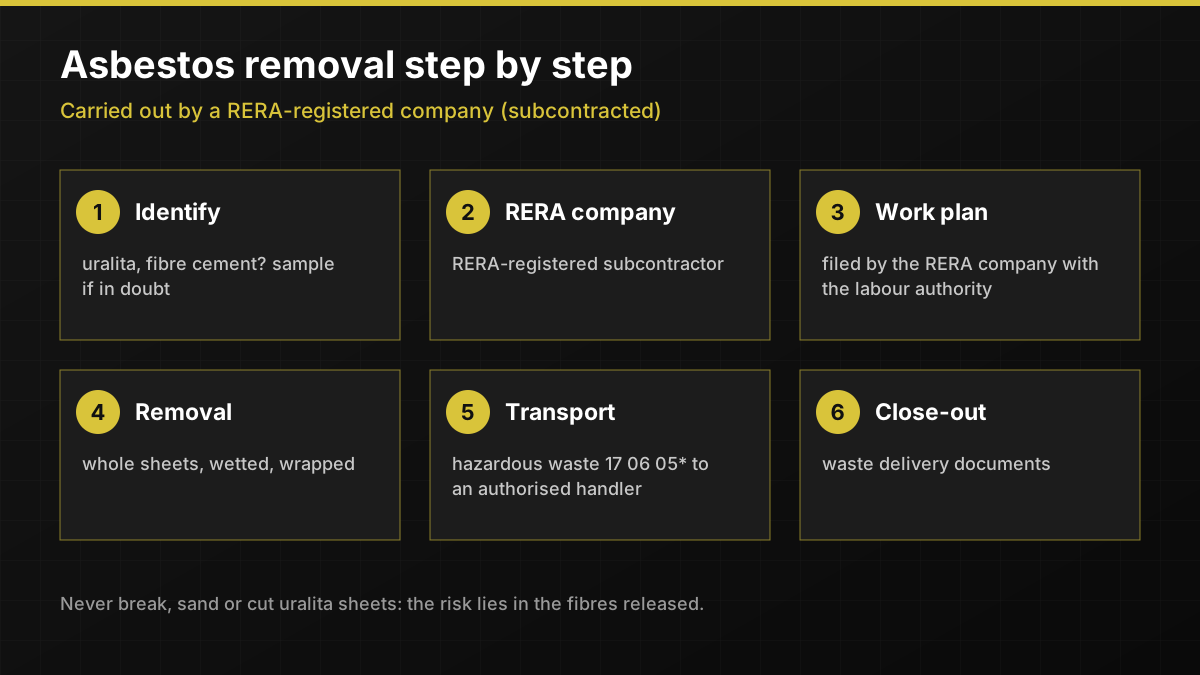
On our jobs this is the RERA subcontractor's part of the work. We start our demolition and rubble removal once the asbestos phase is complete, which is the simplest way to keep the two waste streams from ever meeting.
Where does asbestos waste end up?
Asbestos waste must be delivered to an authorised waste manager (gestor autorizado) for that type of waste. It does not belong in a construction skip, a household bin, a garden waste collection or a ditch at the edge of a finca.
Owners often ask whether they can take a few sheets to a municipal collection point (punto limpio) themselves. The rules of each punto limpio are set locally, and we do not give a general answer. What we can say is that the route we use is always the same: the RERA company removes and packages the material and delivers it to an authorised manager, and the paperwork of that delivery is part of the job.
What happens to the rest of the demolition waste?
Asbestos is often only one part of the material on a job. The rest follows the general rules for construction and demolition waste, which have tightened in recent years:
- Sorting: since 1 July 2022, non-hazardous construction and demolition waste must be sorted at least into wood, mineral fractions (concrete, bricks, tiles, ceramics, stone), metals, glass, plastic and plaster, with reusable elements set aside (Ley 7/2022, art. 30.2).
- Selective demolition: demolition should preferably be selective, and it has been mandatory since 1 January 2024 (Ley 7/2022, art. 30.3).
- Plans: under Real Decreto 105/2008, the project includes an estudio de gestión de residuos prepared on the promotor's side by the técnico, and the contractor prepares a plan de gestión de residuos approved by the dirección facultativa.
On our jobs the materials are sorted on site, the waste goes to an authorised facility and the client receives the delivery receipts (justificantes de entrega). The asbestos phase comes first, then the conventional demolition – see asbestos removal before demolition for how the two fit together.
Waste deposits and municipal requirements in Andalusia
In Andalusia, construction and demolition waste is also subject to regional rules: Ley 3/2023, de 30 de marzo, de Economía Circular de Andalucía is in force, and Decreto 73/2012 (the Andalusian waste regulation) still applies as amended.
One practical consequence for owners is the fianza o garantía for construction and demolition waste that town halls require. Its amount depends on the municipal ordinance, and it is returned once delivery of the waste to an authorised manager has been proven. That is one more reason why the delivery papers matter: without them, recovering the deposit becomes difficult.
Because the deposit is linked to proof of delivery, the papers for the asbestos waste and for the ordinary fractions should be collected together and handed over in one go when the deposit is reclaimed. Missing a single receipt can hold up the whole refund.
Your técnico or the town hall will tell you how the deposit works in your municipality. Our sister site has a dedicated guide on waste deposits in Andalusia that explains the logic in more detail.
Which documents should the owner keep?
When the job is finished, the owner should be able to put a small, complete file in the property's records. For an asbestos job that includes:
- identification of the RERA-registered company that carried out the removal;
- confirmation that the removal was done under an approved work plan for that site;
- the documents of delivery of the asbestos waste (17 06 05*) to an authorised manager;
- the delivery receipts for the other waste fractions of the job;
- photos of the element before and after removal.
These papers serve several purposes: recovering the municipal waste deposit, answering a buyer's or surveyor's questions, informing a community of owners, and simply knowing years later what was done. For owners managing from abroad, ask for them to be sent by e-mail as soon as they are available, rather than collected «next time you are in Spain».
Large quantities: warehouses, farms and whole roofs
Industrial and agricultural roofs produce much larger volumes of asbestos cement than a garage or a porch. On a nave or a farm store, the logistics of packaging, interim storage on site and transport become a significant part of the planning, alongside safe access to the roof.
For these jobs, think early about where packaged waste can be stored safely on the plot, how vehicles will access it and how the asbestos phase is sequenced with the dismantling of the steel or concrete structure. Our page on asbestos in warehouses covers that type of building, and uralita roof removal covers residential roofs. For the planning side of the asbestos phase, see our guide to the asbestos work plan.
Sources
Frequently asked questions
Is uralita hazardous waste in Spain?
Yes. Construction materials containing asbestos carry the hazardous LER code 17 06 05* and must never be mixed with other waste (Ley 7/2022, art. 30.1).
Can I put broken uralita in a building skip?
No. Asbestos waste must be kept separate and delivered to an authorised manager; mixing it with rubble contaminates the whole load.
Can I take uralita to the punto limpio?
Each punto limpio sets its own rules, so check locally. On our jobs the RERA company packages the material and delivers it to an authorised manager.
Who transports asbestos waste?
The RERA-registered company organises the separate packaging and delivery to an authorised manager as part of its work.
What does the asterisk in 17 06 05* mean?
It marks the code as hazardous waste in the European List of Waste.
What documents prove correct disposal?
The documents of delivery of the asbestos waste to an authorised manager, together with the receipts for the other waste fractions of the job.
Does the town hall ask for a waste deposit?
In Andalusia, town halls require a fianza or garantía for construction and demolition waste; the amount depends on the ordinance and it is returned once delivery to an authorised manager is proven.
What happens to the bricks, concrete and wood from the same job?
They are sorted by fractions as required by Ley 7/2022 art. 30.2 and delivered to an authorised facility, with receipts for the client.
Is selective demolition compulsory?
Yes. Under Ley 7/2022 art. 30.3 selective demolition has been mandatory since 1 January 2024.
Who prepares the waste management plan?
Under Real Decreto 105/2008 the contractor prepares the plan de gestión de residuos, based on the estudio de gestión de residuos in the project, and the dirección facultativa approves it.