In short
The 14th additional provision of Ley 7/2022 required town halls to draw up a census of installations and sites containing asbestos within one year of the law's entry into force, and set the goal of dealing with higher-risk public buildings before 2028. It does not, in the provisions we rely on, set a date by which private owners must remove asbestos. For a private property, decisions are usually driven by condition, renovation, demolition or a sale.
Contents
- What does Ley 7/2022 say about asbestos inventories?
- What is a municipal asbestos census for?
- Does the census oblige private owners to remove asbestos?
- When is removal sensible anyway?
- How can you find out what your town hall has done?
- What does the census mean for communities and commercial buildings?
- Why the census is no substitute for checking your own property
- A sensible plan for owners, step by step
- Frequently asked questions
What does Ley 7/2022 say about asbestos inventories?
Ley 7/2022, de 8 de abril, de residuos y suelos contaminados para una economía circular is Spain's general waste law. Among its many provisions, its 14th additional provision deals with asbestos in buildings and installations.
Two points from that provision are the ones that matter for owners:
- town halls had to draw up a census of installations and sites with asbestos within one year of the law entering into force;
- higher-risk public buildings were to be dealt with before 2028.
That is the scope of the statement we can make with confidence. Anything beyond it – precise categories, inspection methods, or what each municipality has done since – depends on later rules and on local practice, and we prefer not to guess.
It is also worth placing the provision in context. Ley 7/2022 is a waste law, so its main concern is how asbestos ends up being managed once it is removed: article 30.1 requires hazardous substances, and asbestos in particular, to be handled safely and never mixed with other waste. The census is the step that comes before – knowing where the material is – and the labour rules of Real Decreto 847/2026 govern the step in between, the removal itself.
What is a municipal asbestos census for?
A census is a planning tool. Its purpose is to give the public administration a picture of where asbestos-containing materials are, so that removal can be prioritised and organised rather than left to chance. The law places the obligation on the ayuntamiento, not on each owner individually.
In the provincia de Málaga that means a very wide range of situations: coastal towns with large urbanizaciones built over several decades, inland pueblos with traditional houses and agricultural annexes, and industrial estates around the capital and the Guadalhorce valley. A census helps a town hall see whether its asbestos is concentrated in public buildings, in industrial areas or scattered across private homes and fincas.
For a foreign owner, the main practical consequence is awareness: asbestos in buildings is on the municipal agenda, and the topic is more likely to come up in planning, in community meetings and in property transactions than it was a few years ago.
Does the census oblige private owners to remove asbestos?
Not on the basis of the provision described above. The 14th additional provision sets duties for town halls and a timetable for higher-risk public buildings. It does not set a fixed date by which private owners must remove asbestos, and we do not tell owners otherwise.
Be wary of anyone who presents the census as a legal deadline for your garage roof or rooftop tank. It is a common sales argument, and it usually comes with pressure to sign quickly. A good decision on asbestos is based on the condition of the material and your plans for the property, not on an invented countdown.
When is removal sensible anyway?
Even without a legal deadline, there are good reasons to act. In practice, owners usually decide to remove asbestos cement in these situations:
- Deterioration: sheets that are cracked, broken, heavily weathered or leaking.
- Works planned: a renovation, extension, solar installation or demolition that would require drilling, cutting or taking the element down.
- Sale or purchase: buyers increasingly ask about uralita, and a documented removal is easier to explain than a suspect roof.
- Change of use: converting a storeroom, stable or garage into living space or a rental unit.
- Peace of mind: owners who manage the house from abroad and prefer not to leave a known issue for later.
The questions in our guide to recognising uralita help you decide which elements on your plot actually fall into these categories.
How can you find out what your town hall has done?
Each ayuntamiento organises its own information, so the practical route is to ask locally. Useful steps are:
- check the town hall's website for the environment or urban-planning department and any published asbestos information;
- ask at the urbanismo or medio ambiente counter, or through the electronic office, whether a census has been published and how it is used;
- in an apartment building, ask the administrador de fincas whether the community has received any communication about asbestos;
- if you have a técnico for a planned renovation or demolition, ask them to include the question in their contacts with the town hall.
Remember that municipal procedures vary between Málaga city, Marbella, Mijas, Nerja, Ronda and the smaller municipalities. We do not list municipal details we have not verified; for each town, the ayuntamiento itself is the authority on what it has published.
What does the census mean for communities and commercial buildings?
The census logic of «know where the asbestos is» is particularly relevant for two types of property that are common in the province.
Communities of owners. Older blocks often have asbestos cement in shared elements: rooftop tanks, downpipes in service shafts, roofs of storerooms or plant rooms. Decisions on common elements are taken collectively, and the community should be informed and agree before works on them. Our guide on asbestos in a community of owners and the communities service page explain how that usually plays out.
Warehouses, workshops and farm buildings. Large fibre-cement roofs on naves and agricultural stores represent big quantities of material in one place. Owners who plan to sell, let or demolish such buildings tend to look at removal first; see asbestos in warehouses. If the whole building is coming down after the asbestos phase, our sister site covers warehouse and industrial demolition.
Why the census is no substitute for checking your own property
Even where a town hall has compiled a thorough census, it is a municipal overview, not a survey of your house. It cannot tell you whether the buried irrigation pipe at the bottom of your finca is asbestos cement, or whether the storeroom roof your predecessor added was replaced at some point. Only an inspection of the actual elements, and where needed an analysis, does that.
There is also a timing gap. Properties change hands, annexes are built and demolished, and roofs are replaced, so any list compiled at one moment will drift away from reality over the years. Treat the census as context and your own inventory as the working document.
For buyers this is particularly relevant. Absence from a public list is not evidence that a property is free of asbestos. Ask the seller about each fibre-cement element, look at the outbuildings yourself or through a trusted surveyor, and ask for papers from any earlier removal. If a removal was done in the past by a RERA-registered company, there should be documentation of the work and of the delivery of the asbestos waste to an authorised manager.
For sellers, the reverse applies: a short written record of which elements were removed, when and by which registered company answers most buyers' questions before they are asked, and it avoids last-minute renegotiation once a surveyor spots grey sheets on the garage.
A sensible plan for owners, step by step
If you have, or suspect, asbestos cement on your property, this sequence keeps you in control without overreacting:
- Inventory your own plot. List each suspect element: roofs, tanks, pipes, flues, panels. Photograph them.
- Assess condition. Note cracks, breaks, heavy weathering, moss and leaks; do not climb on roofs to look.
- Decide the trigger. Is removal linked to a renovation, a demolition, a sale, or just to condition?
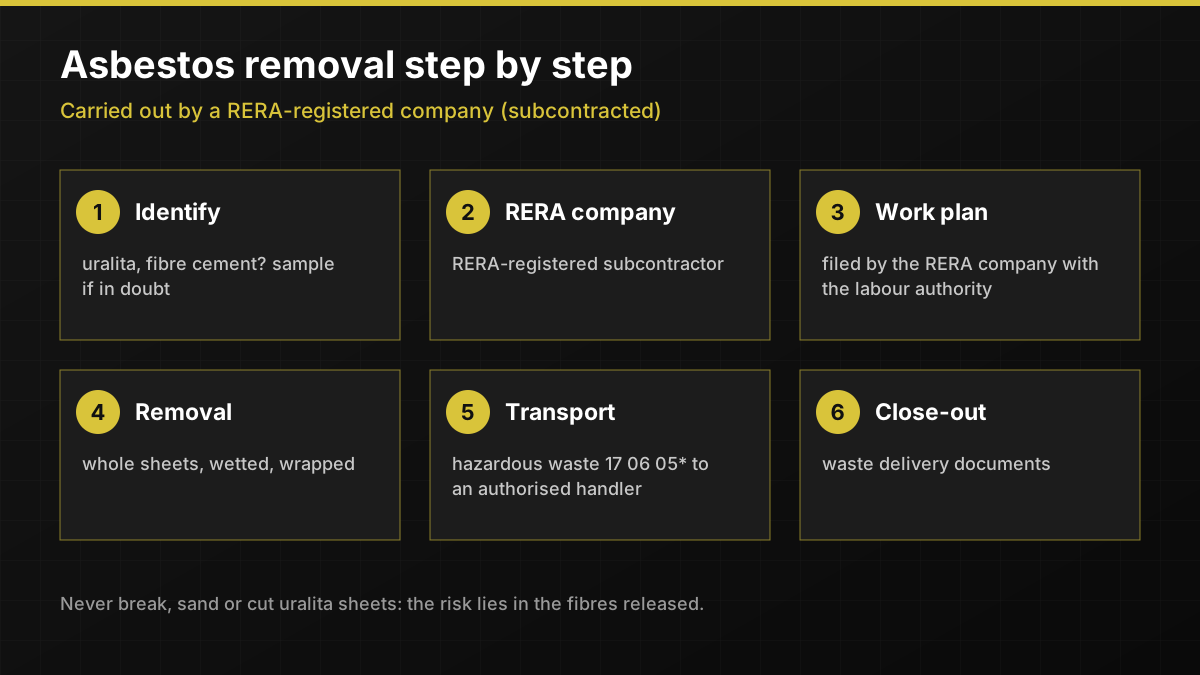
- Get a removal assessment. A RERA-registered company assesses the elements and plans the work; on our jobs it works as our subcontractor.
- Plan the rest. Replacement roof, new tank, demolition or clearance – the sequence is coordinated so that nothing is touched before the asbestos has gone.
- Keep the paperwork. Store the documents of the removal and the waste delivery with the property's papers.
Send us photos and the municipio by e-mail or WhatsApp and we will tell you, without obligation, how the job would be organised.
Sources
Frequently asked questions
Which law requires municipal asbestos censuses?
Ley 7/2022, de residuos y suelos contaminados para una economía circular, in its 14th additional provision.
What deadline did town halls have for the census?
One year from the law's entry into force, according to the 14th additional provision.
Is there a deadline for removing asbestos from public buildings?
The provision aims for higher-risk public buildings to be dealt with before 2028.
Do private owners have to remove asbestos by 2028?
No such date for private owners appears in the provisions we rely on. Be cautious with anyone who claims otherwise.
Will my property appear in the municipal census?
That depends on how each town hall compiles its census. Ask the ayuntamiento's urban-planning or environment department.
Does the census change who can remove asbestos?
No. Removal is still reserved to RERA-registered companies under a work plan approved by the provincial labour authority.
Does Ley 7/2022 say anything else about asbestos?
Yes: under its article 30.1 asbestos must be handled safely and never mixed with other waste.
Should I remove uralita before selling my villa?
It is not a legal requirement in the rules we rely on, but a documented removal is often easier to explain to buyers than a suspect roof.
How do I find out if my town hall has a census?
Check its website and ask at the urbanismo or medio ambiente department or through its electronic office.
Is the census relevant to my community of owners?
It is a good prompt to review shared elements such as tanks, downpipes and roofs, which the community decides on collectively.