
In short
An old uralita roof is removed by a RERA-registered company under a work plan approved by the provincial labour authority; the sheets are taken away whole, wrapped as hazardous waste. On our jobs that company is our subcontractor, while we coordinate dates, demolish whatever goes afterwards and line up the new roof with your builder.
Contents
- How to tell whether you have an old asbestos roof
- Why remove an uralita roof rather than leave it?
- The uralita roof removal process, step by step
- Garages, carports, porches and sheds
- Whole house roofs on older villas and fincas
- Do you need a permit to remove an uralita roof in Spain?
- Replacing the roof after removal
- Frequently asked questions
How to tell whether you have an old asbestos roof
Most uralita roofs are corrugated grey sheets, either the large wavy profile used on sheds or the finer profile used on porches and garages. Over the years they turn darker, grow lichen and moss, and the edges become brittle. Some have been painted red or green to look like tiles. Asbestos cement sheets were also used as a hidden layer under ceramic tiles on some houses.
From the ground you can look for the fixing hooks, the overlapping edges and any manufacturer markings on the underside, but you should never break off a piece to check. The only reliable confirmation is a laboratory analysis of a sample, and sampling is itself best left to a professional. Our guide on how to recognise uralita shows the typical signs, and the post on the best and worst ways to deal with old uralita explains what not to do while you decide.
Why remove an uralita roof rather than leave it?
An intact roof that nobody touches can stay where it is for a while; the problem starts when it cracks, crumbles, leaks or is in the way of other works. Owners usually decide to remove an uralita roof because the sheets are broken, because the building is being renovated or sold, because the roof leaks and cannot be repaired without drilling, or simply for peace of mind before letting the house.
The alternative some owners consider is sealing or overcladding the old roof. Whether that suits depends on the condition of the sheets and the plans for the building; our post on encapsulating or removing an asbestos roof compares both, and whether it is worth removing uralita in good condition looks at the case where nothing is broken yet. Any work that disturbs the sheets should be left to a RERA-registered company.
The uralita roof removal process, step by step
The uralita roof removal process follows the same logic on a small carport as on a large villa:
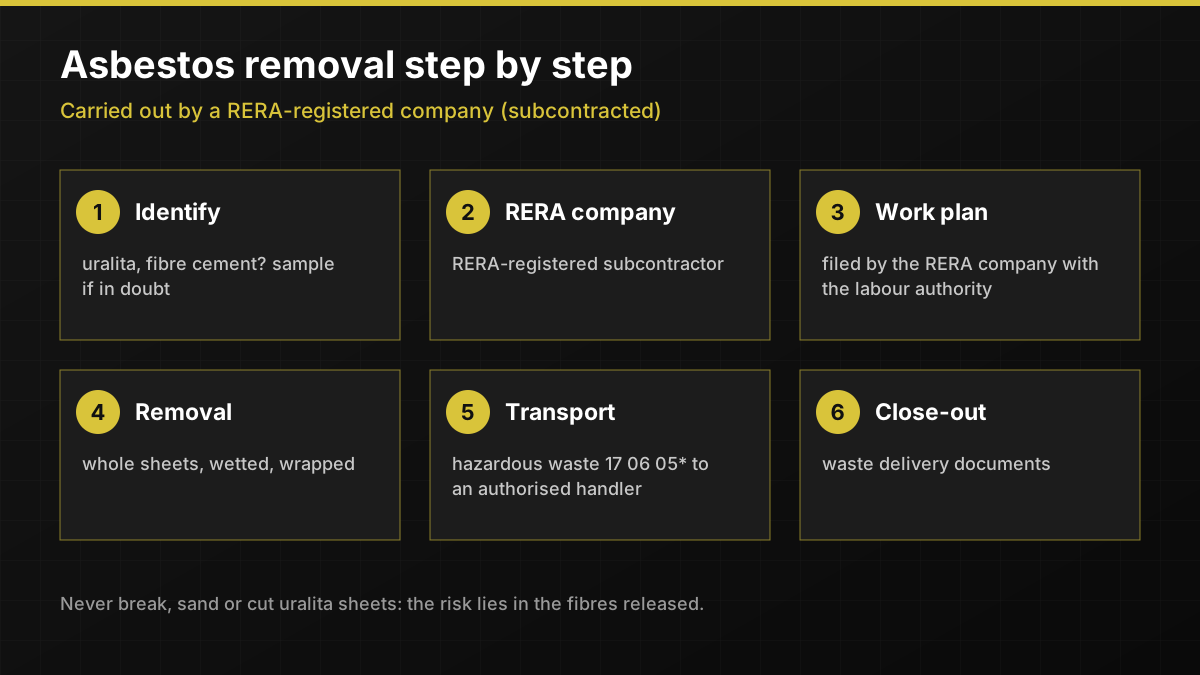
- Inventory. You send photos and rough dimensions; we identify the roofs and any other fibre-cement elements on the property.
- Work plan. The RERA-registered subcontractor visits, prepares its work plan and files it with the labour authority of the province; the start of the work is notified in advance.
- Removal. The sheets are dampened, the fixings released and the sheets lowered whole where possible – not broken or thrown. They are wrapped and labelled as hazardous waste.
- Disposal. The asbestos cement goes to an authorised manager as waste 17 06 05*, separately from all other rubble.
- Next phase. We demolish the structure if it is coming down, or leave it ready for the roofer who fits the new cover.
The asbestos removal is carried out by a company inscribed in the RERA that works as our subcontractor; we coordinate that phase and carry out the rest of the demolition.
Garages, carports, porches and sheds
Small outbuildings are where most owners first meet the problem. A garage with an uralita roof, a carport, a covered terrace or a tool shed is often the last part of the property to be renovated. Typical decisions are:
- Keep the structure, replace the roof – common for sound brick garages and porches;
- Remove roof and structure – common for timber carports and sheds in poor condition;
- Remove everything and reuse the space – for example to enlarge a garden, build an annex or open the view.
If the outbuilding comes down completely, we demolish it once the asbestos is gone, break out its slab if needed and take away the rubble. Larger garden structures – old pools, terraces, retaining walls – are covered by our sister site for terraces and outbuildings.
Whole house roofs on older villas and fincas
On some country houses and older villas the whole main roof is fibre-cement, sometimes hidden under tiles. Removing it means the house is open until the new roof is on, so timing matters more than anywhere else. We agree the sequence with your builder or roofer before the work plan is filed: removal, any partial demolition of chimneys or parapets, inspection of the beams and the new deck.
If the house itself is being demolished, the asbestos roof comes off first and the demolition follows, either by our team or – for a full knock-down – as described on our sister site's page on house and villa demolition. Fibre-cement tanks and flues on the same roof are best included in the same job; see asbestos pipes and tanks.
Do you need a permit to remove an uralita roof in Spain?
Two separate things are involved. On the asbestos side, the RERA-registered company needs its work plan approved by the provincial labour authority before starting; that is its responsibility, not yours. On the planning side, the owner or their técnico checks with the town hall which procedure the works require – a declaración responsable or a licencia – and whether the public road will be occupied by a skip, lift or scaffold.
In Andalusia, total or partial demolition has generally been done by declaración responsable since Decreto-ley 3/2024, except for protected buildings, protected settings and archaeological zones, where a licencia is still needed. Each ayuntamiento sets the documents in its ordinance. Replacing the roof is a building work in its own right, which your technician or builder should check with the town hall at the same time.
Replacing the roof after removal
The most common replacements are insulated sandwich panels, metal sheet, or a new timber or concrete deck finished with tiles. The choice depends on the building, the budget, the look the town hall accepts and how quickly the roof must be closed. Our guide on replacing an uralita roof compares them.
We do not install new roofs ourselves; we coordinate dates so that the roofer can start as soon as the RERA-registered company has finished. For cost factors – surface, height, access, condition, what follows – see the post on what affects the cost of removing an uralita roof and our sister site's demolition calculator.
Frequently asked questions
How do I know if my roof is uralita with asbestos?
Grey corrugated fibre-cement sheets on an older building are likely to be asbestos cement. Only a laboratory analysis of a sample confirms it; do not break off a piece yourself.
Can I remove an uralita roof myself in Spain?
No. Removing asbestos cement roof sheets is reserved for RERA-registered companies working under an approved work plan.
Can a roofer replace the uralita roof?
A roofer can fit the new roof, but the old asbestos sheets must be removed first by a RERA-registered company.
Are the sheets broken during removal?
No – they are dampened, unfixed and lowered whole wherever possible, then wrapped and labelled as hazardous waste.
Can I leave an old uralita roof in place?
There is no fixed date by which private owners must remove it. An intact roof is often left for a time; a cracked or crumbling one should be assessed.
Will my house be left without a roof?
Only between the removal and the new roof. We agree the sequence with your roofer beforehand so that the gap is as short as possible.
Can I paint over my uralita roof?
Painting does not remove the asbestos, and preparing the surface by brushing or pressure-washing disturbs it. Get advice before doing any work on the sheets.
Is there uralita under my roof tiles?
On some older houses, yes. If the roof is being renovated, mention it so the tiles can be lifted carefully and the layer underneath identified.
Do you demolish the garage after removing its roof?
Yes, if you want. Once the asbestos is gone we demolish the walls and slab and take away the rubble.
How long does an uralita roof removal take?
It depends on the surface, access and the approval of the work plan. We give you a realistic schedule once the RERA-registered company has seen the roof.
Do I get proof that the sheets were disposed of correctly?
Yes. The asbestos waste is delivered to an authorised manager and you receive the documentation together with the receipts for the other rubble.