In short
Rooftop water tanks, downpipes, flues and buried pipes made of fibre-cement on older properties should be treated as asbestos cement until analysed. Leave them undisturbed, do not cut or break them to replace them, and have them removed by a RERA-registered company under an approved work plan. The plumber or installer then fits the replacement once the asbestos elements have gone.
Contents
- Which pipes and tanks are typically asbestos cement?
- How do you recognise a fibre-cement tank or pipe?
- Why are tanks and pipes easy to damage?
- Do you have to remove them?
- How is the removal of a tank or pipe organised?
- Tanks and downpipes in blocks of flats
- What should you tell your plumber or installer?
- Buried pipes on fincas and large plots
- Frequently asked questions
Which pipes and tanks are typically asbestos cement?
On older houses, apartment blocks and fincas in the province, fibre-cement was used for a whole range of water and air installations. The usual suspects are:
- Rooftop water tanks (depósitos): square or cylindrical grey tanks, sometimes with a fibre-cement lid, on flat roofs or in roof spaces.
- Downpipes (bajantes): rainwater and waste pipes on façades, in light wells and inside service shafts in blocks of flats.
- Flues and vent pipes: grey tubes from kitchens, water heaters, boilers and fireplaces.
- Buried pipes: irrigation lines, drainage and older supply pipes on rural plots and in large gardens.
- Gutters and channels: fibre-cement gutters on outbuildings and farm sheds.
Public supply mains in the street belong to the water utility and are not something an owner deals with. This guide is about what sits within your property or your community's common elements.
Age is again the best clue. If the plumbing has never been renewed and the house or block dates from the decades when fibre-cement was widely used, assume that the original tank and pipes may be asbestos cement until shown otherwise.
How do you recognise a fibre-cement tank or pipe?
Fibre-cement tanks and pipes share the look of uralita roofing: grey, matt, slightly rough and rigid, with thicker walls than plastic. Pipes often have characteristic sleeve joints – a wider collar where two lengths meet. Tanks are heavy, and many show a ridge or lip around the top edge where the lid sits.
Clues that point the other way include a smooth glossy surface (PVC), a white, black or blue colour (plastic tanks and polyethylene pipes) or a metallic ring when tapped. Where the element is painted or encrusted, those clues disappear and only analysis tells. Our general guide on how to recognise uralita lists the visual signs in more detail.
Inside homes, asbestos cement pipes can be boxed in behind plasterboard or tiles. If you are planning a kitchen or bathroom renovation, read our sister site's guide to hidden asbestos in interior renovations before anyone opens walls.
Why are tanks and pipes easy to damage?
The risk with pipes and tanks is less about weathering and more about accidental disturbance. Typical situations are:
- a plumber cuts a downpipe with an angle grinder to connect a new PVC section;
- a tank is broken into pieces on the roof because it will not fit through the stairwell;
- a gardener digs up and snaps an old irrigation pipe with a mini-digger;
- a solar installer drills through a flue or tank stand;
- a handyman sands or scrapes a painted downpipe before repainting the façade.
Each of these turns a stable element into broken asbestos cement and dust. The safe rule is simple: if it is grey fibre-cement and old, nobody cuts, drills, breaks or sands it until it has been assessed, and removal is left to a RERA-registered company.
Do you have to remove them?
Not necessarily. There is no fixed date by which private owners must remove asbestos under the rules we rely on. A tank or pipe in reasonable condition that nobody touches can stay while you plan.
Removal usually makes sense when:
- the tank leaks, is cracked or has a broken lid, or is no longer used;
- the plumbing is being renewed, and the old pipes would otherwise be cut;
- a roof terrace, solar panels or an extension are planned where the tank stands;
- the building is being demolished or heavily renovated;
- you are selling and want to remove a known question mark from the survey.
Unused tanks are a frequent case. Many houses were connected to a mains supply years ago and the rooftop tank simply stayed. Removing it is a self-contained job that can be planned at a calm moment rather than in the middle of a renovation.
How is the removal of a tank or pipe organised?
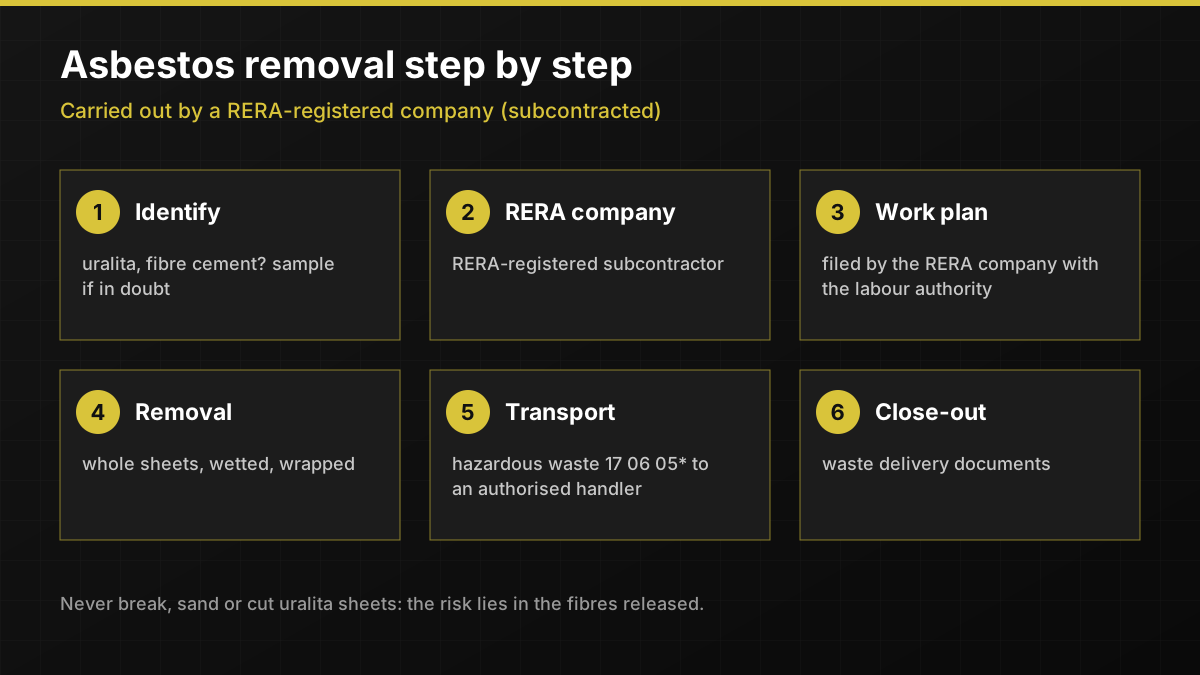
The legal frame is the same as for a roof. Only companies registered in the RERA may remove asbestos-containing materials, under a work plan approved by the labour authority of the province, now governed by Real Decreto 847/2026. On our jobs, the removal is carried out by a RERA-registered company working as our subcontractor, and we coordinate the rest of the work.
A typical sequence for a rooftop tank and its pipes looks like this:
- Information: photos of the tank, its supports, the connections and the access route from the street to the roof.
- Disconnection: your plumber or the community's maintenance company isolates and drains the installation in advance.
- Plan: the RERA company prepares and files its work plan and notifies the start of works.
- Removal: the tank and pipe sections are taken out as whole as practicable, with the methods set in the plan, and packaged.
- Waste: the packaged asbestos cement leaves the site separately and goes to an authorised manager as LER 17 06 05*.
- Replacement: once the asbestos phase is complete, the plumber installs the new tank or pipes.
Access is often the decisive factor. A tank on the roof of a three-storey townhouse with a narrow stairwell is a different job from one on a single-storey villa with a driveway alongside. That is why accurate photos of the route matter as much as photos of the tank itself.
Tanks and downpipes in blocks of flats
In apartment buildings, tanks and downpipes are usually common elements. Under Ley 49/1960 de Propiedad Horizontal, the community must be informed before works on structural or façade elements, and works affecting common elements need the agreement of the owners' meeting. In practice, that means the president or the administrador de fincas is your first contact, even if the pipe runs past your own kitchen.
Shared downpipes in service shafts are a classic case. One owner renovating a bathroom finds an old fibre-cement downpipe behind the tiles; replacing that pipe affects every flat connected to it. The sensible route is to stop, inform the community and plan a joint solution rather than cutting out «just my section».
Our page on asbestos in communities of owners and the guide on who decides and who pays in a community cover this situation in more depth.
What should you tell your plumber or installer?
Plumbers, solar installers and pool technicians are the trades most likely to meet asbestos cement pipes and tanks in the course of ordinary work. A short briefing before they start prevents most accidental damage:
- Point out every suspect element on the job: tank, downpipes, flue, buried lines. Do not assume they will recognise them.
- Agree that they will not cut, drill or remove any of those elements; their work starts after the asbestos phase or around protected elements.
- Ask them to isolate and drain the installation on an agreed date, so the RERA company finds it ready.
- Ask for their new layout in advance, so the removal can be planned to match where the new pipes or tank will go.
- Give them the RERA company's dates, so the replacement can follow without the house being left without water for longer than necessary.
For owners abroad, putting this in a short written message to the plumber, with photos marked up, is often more effective than a phone call. It also leaves a record if questions arise later.
Buried pipes on fincas and large plots
Rural properties in the Axarquía, the Guadalhorce valley or the Serranía de Ronda often have long stretches of old fibre-cement irrigation or drainage pipe under the ground. As long as they stay buried and intact, they are out of sight and mostly out of mind.
The problem arises when ground works begin: a new pool, a driveway, a foundation or a demolition with machinery. Excavators break buried pipes without anyone noticing. Before any digging, ask the previous owner or the person who maintains the irrigation where the old lines run, and mark them. If they cross the area of work, plan their removal by the RERA company as a separate phase before the machines arrive.
This is also where coordination with the rest of the job pays off. If the house or an outbuilding is coming down, the asbestos elements are removed first and the demolition follows; see uralita removal for villas and plots and asbestos pipes and tanks for this specific type of job.
Sources
Frequently asked questions
Are grey rooftop water tanks always asbestos?
Not always, but on older buildings they very often are asbestos cement. Treat them as suspect until a sample has been analysed.
Can my plumber replace an old fibre-cement downpipe?
The plumber can install the new pipe, but the removal of the asbestos cement section is work for a RERA-registered company under an approved work plan.
Can the tank be broken up on the roof to get it down?
That is exactly what should be avoided. The method of removal is set in the RERA company's work plan, which aims to keep elements as whole as practicable.
Is an unused rooftop tank a problem?
Not by itself if it is intact and undisturbed, but it is a convenient element to remove at a calm moment rather than in the middle of other works.
Who disconnects the water before removal?
Your plumber or the community's maintenance company isolates and drains the installation in advance so the RERA company can work on an empty, disconnected element.
Who decides about a shared downpipe in a block of flats?
Works on common elements need the agreement of the owners' meeting; start by informing the president or the administrador de fincas.
What about old buried irrigation pipes?
Leave them undisturbed, locate and mark them before any digging, and plan their removal by the RERA company if they lie in the work area.
Where does the removed tank go?
It is packaged separately and delivered to an authorised manager as hazardous waste LER 17 06 05*, never mixed with other waste.
Do you install the new tank or pipes?
The replacement is done by your plumber or installer once the asbestos phase is complete; we coordinate dates and the rest of the works.
Can you organise the removal if I am not in Spain?
Yes. Send photos of the tank or pipes, the access route and the municipio; you can write to us in English and a key-holder can open up on the day.