
In short
Asbestos cement roofs and wall cladding on warehouses and agricultural buildings are removed by a RERA-registered company working as our subcontractor, under a work plan approved by the provincial labour authority. Afterwards we demolish the structure or prepare it for a new roof, sort the remaining waste and remove it.
Contents
- Why so many warehouses and farm buildings have uralita roofs
- What makes a warehouse roof different from a house roof
- How the job is divided: asbestos first, demolition after
- Keeping a business or a farm running during the work
- Paperwork for warehouse jobs
- Re-roofing or demolishing: deciding what comes next
- What to send us about your warehouse
- Frequently asked questions
Why so many warehouses and farm buildings have uralita roofs
For decades corrugated fibre-cement was the cheapest way to cover a large span: light, easy to fix to steel or timber purlins and resistant to rain. That is why it is still found on small industrial units, agricultural stores, olive and almond warehouses, stables, pig and poultry sheds, garages for machinery and workshops all over the province of Málaga.
These roofs are often the largest single quantity of asbestos cement on a property. Many have also been patched over the years with sheets of different ages, and some have translucent panels or metal sheets mixed in. A clear inventory – which sheets, how many square metres, in what condition – is the starting point for any plan.
What makes a warehouse roof different from a house roof
A warehouse roof is bigger, higher and usually more fragile to walk on. Old fibre-cement sheets can break under a person's weight, so the removal is planned with safe access from below or from platforms, never by simply climbing on the roof. Wall cladding, gutters and downpipes made of the same material are part of the same job.
- Height: eaves and ridges are often well above domestic roofs, which conditions the access equipment.
- Surface: large areas mean more waste to wrap and transport as hazardous material.
- Contents: machinery, stock, feed or animals inside have to be protected or moved.
- Structure: rusted purlins or tired timber may limit how the sheets can be taken off.
The RERA-registered subcontractor reflects all of this in its work plan, which the labour authority of the province approves before the work starts.
How the job is divided: asbestos first, demolition after
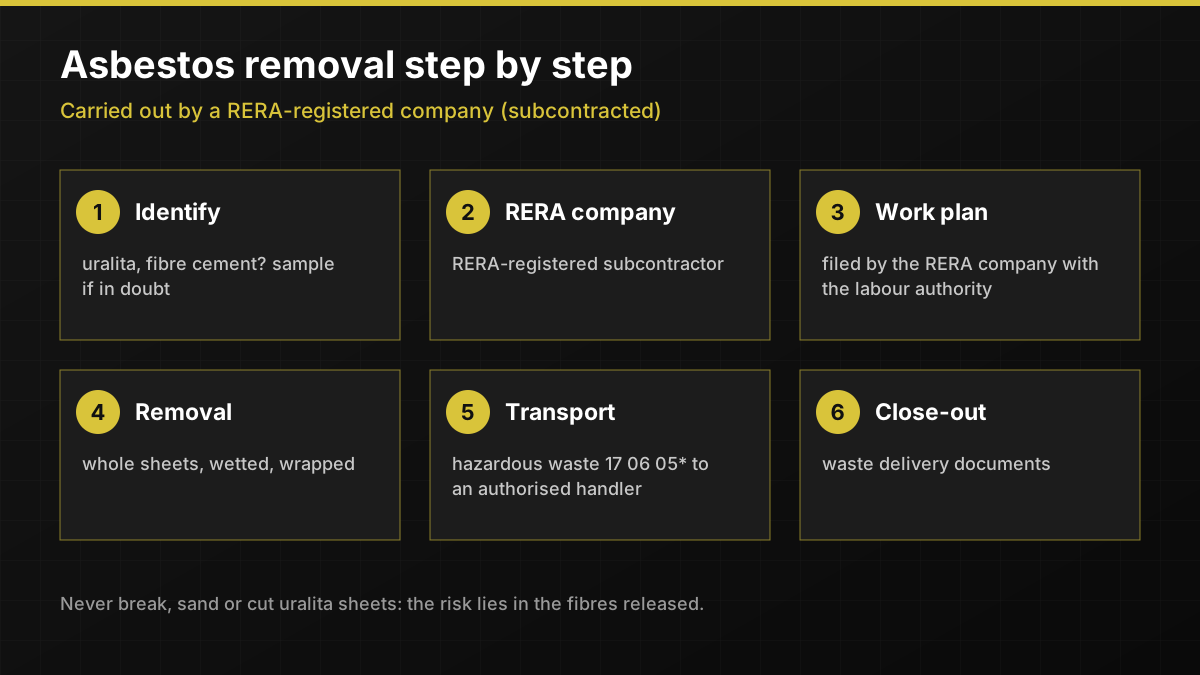
The order never changes: the asbestos-containing material comes off first, and only then does any demolition start. The asbestos removal is carried out by a company registered in the RERA that works as our subcontractor; it prepares and files the work plan, removes the sheets, wraps them and delivers them to an authorised manager as hazardous waste (17 06 05*).
Once the building is free of asbestos cement, we take over. Depending on what you want, we:
- demolish the whole building, including walls, steel or concrete frame and floor slab;
- keep the structure and remove only what is needed for a new roof;
- break out internal partitions, troughs, pits or old installations;
- sort the remaining materials – metal, concrete, brick, wood – and take them to authorised facilities.
For a complete knock-down of a larger industrial building, our sister site Derribos Industriales Málaga describes the machine demolition phase in detail.
Keeping a business or a farm running during the work
A warehouse roof is rarely removed in a building that is completely empty. Workshops want to keep working, farmers need to store harvests or keep animals, and tenants have contracts. The work plan defines the work area and who may be near it, so the first conversation is about what can be moved, what can stay covered and which periods are quieter.
In practice it often helps to remove the roof in sections, to agree dates outside harvest or peak season, and to have the new roof ready to go on as soon as each section is clear. We coordinate those dates between you, the RERA-registered company and the roofer or builder who follows.
If the building is let, tell the tenant early and put the dates in writing. A tenant who knows when the roof will be off can move stock or vehicles in good time, and the work plan can then assume an empty work area rather than improvised protection around goods that should not be there.
Paperwork for warehouse jobs
When two or more companies work on the same site, Real Decreto 1627/1997 expects the promotor to appoint a health and safety coordinator during the works, and each job has a safety study or basic safety study from which the contractor prepares its safety plan. For a warehouse this is usually handled by the technician who also prepares the demolition documentation.
If the building is to be demolished, the owner or their técnico checks with the town hall whether a declaración responsable or a licencia applies; protected buildings, protected settings and archaeological zones still need a licencia. The contractor also prepares a waste management plan for the non-hazardous rubble. Our guide on the asbestos work plan and who approves it explains the asbestos side, and asbestos waste disposal in Spain covers where everything ends up.
Re-roofing or demolishing: deciding what comes next
Owners of older sheds often ask whether it is worth re-roofing at all. The answer depends on the state of the structure, what the building is used for and whether the town hall would allow it to be rebuilt in the same place. A tired timber frame under a broken roof may not justify a new cover; a sound steel frame usually does.
If you keep the building, the guide on replacing an uralita roof compares the usual alternatives. If the question is whether to deal with the roof now or later, the post comparing encapsulating or removing an asbestos roof sets out the arguments. For smaller garages and sheds beside a house, see our page on uralita roof removal.
What to send us about your warehouse
For a first assessment, send photos of the roof from outside and from inside, the approximate length and width of the building, the eaves height, what is stored inside and how a lorry reaches the door. Tell us whether the building stays or goes, and if you already have a technician involved.
The cost depends mainly on surface, height, access, the condition of the sheets and how much demolition follows. Our sister site explains industrial demolition costs, and the post on what affects the cost of removing an uralita roof goes through each factor.
Frequently asked questions
Can farm workers take the old roof off themselves?
No. Removing asbestos cement sheets is reserved for RERA-registered companies under an approved work plan, whoever owns the building.
Is it safe to walk on an old fibre-cement roof?
No. Old sheets can break under a person's weight. Access is planned from below or from platforms, never by walking on the sheets.
Do you also remove the wall cladding?
Yes. Fibre-cement cladding, gutters and downpipes are planned together with the roof by the RERA-registered subcontractor.
Can the warehouse stay in use during the work?
Partly, in many cases. The work plan defines the work area; removing the roof in sections and planning dates around your activity helps.
What happens to the steel frame after the roof comes off?
If the building is demolished, we dismantle or cut the frame and send the metal to authorised recycling. If it stays, it is left ready for the new roof.
Who appoints the safety coordinator?
The promotor – normally the owner – appoints the health and safety coordinator when several companies work on site, usually on the advice of their technician.
Do I need a licence to demolish a farm building?
Check with the town hall through your technician. In Andalusia demolition is generally done by declaración responsable, but protected buildings or settings need a licencia.
Are mixed roofs with metal and fibre-cement sheets a problem?
No, but the inventory must be clear. The fibre-cement sheets go as hazardous waste; metal sheets are removed separately once the asbestos is out.
Can animals stay in the stable next door?
That depends on the distance and the work plan. Raise it at the first visit so it can be planned before dates are fixed.
Where does the rubble go after the demolition?
It is sorted on site into concrete, brick, metal, wood and other fractions and taken to authorised facilities; you receive the delivery receipts.
Do you work on industrial estates and in the countryside alike?
Yes, anywhere in the province of Málaga. Access for lorries is one of the first things we check.