
In short
Fibre-cement tanks, downpipes, flue pipes and buried pipes made of asbestos cement must be removed by a RERA-registered company under an approved work plan. On our jobs that company works as our subcontractor; we coordinate the visit, break out plinths and supports, clear the rubble and keep you informed with photos.
Contents
- Which pipes and tanks in a Spanish house may contain asbestos?
- Why should you not cut out an old fibre-cement tank yourself?
- How the removal is split between the RERA company and our team
- Tanks on flat roofs and in apartment blocks
- Buried asbestos pipes on fincas and rural plots
- Downpipes and flues on façades: height and scaffolding
- What affects the cost of removing tanks and pipes?
- Frequently asked questions
Which pipes and tanks in a Spanish house may contain asbestos?
Any grey, slightly rough fibre-cement pipe or tank installed several decades ago may be asbestos cement. On the properties we see across the province of Málaga, the usual suspects are:
- Water tanks (depósitos) on flat roofs and in lofts, square or cylindrical, often with a loose lid of the same material;
- Downpipes (bajantes) on façades and in internal shafts, sometimes painted over so the grey surface no longer shows;
- Chimney and boiler flues, including the short sections that cross a roof;
- Buried water mains and irrigation pipes on fincas and older rural plots;
- Sewer and drainage pipes under patios and gardens, which only appear when someone digs.
Paint, render or a layer of lichen can hide the material completely. If you are unsure, our guide on recognising uralita explains what to look for from a safe distance, and the dedicated guide on asbestos cement pipes and water tanks covers the options in more depth.
Why should you not cut out an old fibre-cement tank yourself?
Because cutting, breaking or drilling asbestos cement releases fibres, and because demolishing or removing asbestos-containing material is reserved by law for companies registered in the RERA. Real Decreto 847/2026, in force since late October 2026, sets the rules: the work is done under a plan approved by the provincial labour authority, and its start is notified in advance.
Tanks are a particular temptation for DIY because they look like a simple container. In reality they are often stuck to their base, full of sediment and too heavy to lift whole from a roof without breaking. A plumber who disconnects the pipes is fine; a plumber who smashes the tank to get it down the stairs is not. Our post Can I remove asbestos myself in Spain? compares the DIY idea with what a registered company actually does.
How the removal is split between the RERA company and our team
The asbestos removal is carried out by a company inscribed in the RERA that works as our subcontractor. It inspects the elements, prepares its work plan, files it with the labour authority and, once cleared to start, removes the tanks and pipe sections, wraps them and takes them away as hazardous waste.
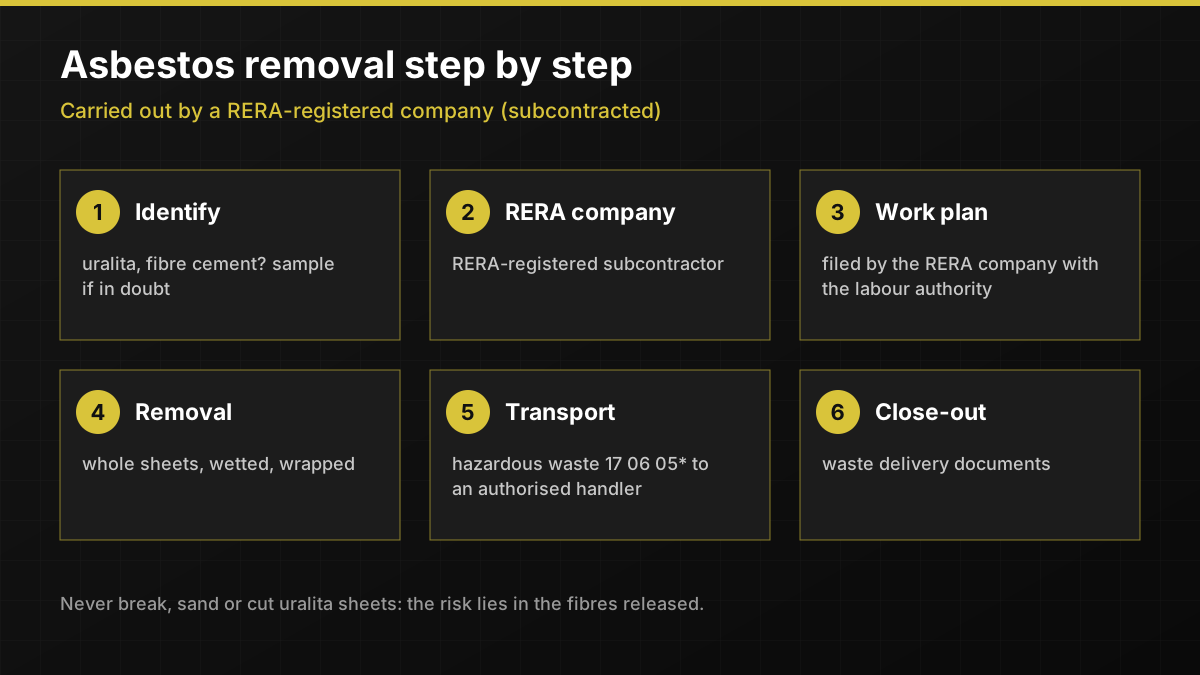
Everything that does not contain asbestos is our part of the job:
- breaking out the brick or concrete plinths that carried the tank;
- removing metal brackets, supports and old fixings once the fibre-cement has gone;
- opening and closing small sections of wall or patio where a pipe ran;
- clearing and sorting the rubble and taking it to an authorised facility.
Your plumber or installer then fits the new tank, downpipe or flue. We coordinate dates so that the house is not left without water or with an open roof longer than necessary.
Tanks on flat roofs and in apartment blocks
A tank on the flat roof of a detached villa is usually straightforward: access is through the house or by ladder, and the old plinth can be broken out the same week. On an apartment block the tanks often sit on a shared roof and belong to the community, or to individual owners who have forgotten they still exist.
In that case the community of owners needs to agree the work, because the roof is a common element. Our page on asbestos in communities of owners explains how such a job is prepared, and the guide on who decides and who pays in a community helps you raise it with the administrator. Disused tanks are often the easiest item to approve: nobody is using them, and removing them frees up roof space.
Buried asbestos pipes on fincas and rural plots
On many fincas in the Guadalhorce valley, the Axarquía and around Antequera, water still arrives – or used to – through buried fibre-cement mains. These pipes are usually discovered when a new connection, a pool or a foundation is dug. The safest approach is to stop the digging at that point, photograph the pipe and leave it in place until it can be assessed.
If the pipe is no longer used and lies deep, an owner may decide to leave it where it is and record its route. If it has to come out – because it crosses the footprint of a new building or a new trench – the exposed sections are removed by the RERA-registered company, and we carry out the surrounding earth and rubble work as part of the demolition. Pure excavation or landscaping is not something we offer on its own; ask us about your case.
Downpipes and flues on façades: height and scaffolding
Downpipes and flues are light, but they are usually high up. Depending on the building, the work is done from a mobile platform, a tower scaffold or a façade scaffold. If any of this stands on the pavement, the town hall must authorise the occupation of the public road before the work starts; your technician or the community administrator usually requests it.
When the whole roof is also fibre-cement, it is more sensible to plan pipes and roof together and avoid erecting access twice. Our page on uralita roof removal covers roof sheets, and the page on removing all the uralita from a property explains how to group several elements into one job.
What affects the cost of removing tanks and pipes?
The main factors are the number and size of the elements, their height, how they are reached, whether they are intact or broken, and what has to be demolished around them. A single empty tank on an accessible roof is a very different job from three tanks on a tall building with no lift. The waste goes as hazardous material, so the quantity matters too.
We do not publish prices; for a first idea, our sister site's page on asbestos removal costs lists the factors, and our post on common concerns before an asbestos removal answers the practical questions owners ask before agreeing to the work.
Frequently asked questions
Does every old water tank in Spain contain asbestos?
No, but many grey fibre-cement tanks installed decades ago do. Only a laboratory analysis confirms it, so treat an old fibre-cement tank as asbestos cement until a professional says otherwise.
Can my plumber remove the old fibre-cement tank?
Your plumber can disconnect it, but removing the asbestos cement tank itself is work for a RERA-registered company under an approved work plan.
Is a painted downpipe still a problem?
Paint hides the material but does not change it. A painted fibre-cement downpipe is treated the same way as a bare one when it is removed.
What do you do with the concrete plinth under the tank?
Once the RERA-registered company has removed the tank, we break out the plinth, remove the rubble and leave the roof ready for the new installation.
We found an old pipe while digging. What now?
Stop digging at that spot, keep people away, photograph the pipe and send us the photos. Do not break or cut it to see what it is made of.
Can a buried asbestos pipe stay in the ground?
If it is disused and does not interfere with any works, owners sometimes leave it and record its route. If it has to come out, the exposed sections are removed by a RERA-registered company.
Will I be without water during the work?
We coordinate with your plumber so that the new tank or connection follows the removal as closely as possible. The exact timing depends on the subcontractor's work plan.
Do I need permission from the community to remove my own tank on a shared roof?
The roof of a block is a common element, so speak to the administrator first; works affecting common elements need the owners' meeting agreement.
Is scaffolding needed for flues and downpipes?
Often a platform or tower scaffold is enough; on taller buildings a façade scaffold may be needed. If it stands on the pavement, a public-road permit is required.
Where are the pipes and tanks taken?
They are wrapped and labelled as hazardous waste 17 06 05* and delivered to an authorised waste manager, never mixed with other rubble.
Can you remove tanks and the roof in the same job?
Yes, and it usually makes sense: the access is shared and the RERA-registered company plans all the asbestos elements together.