In short
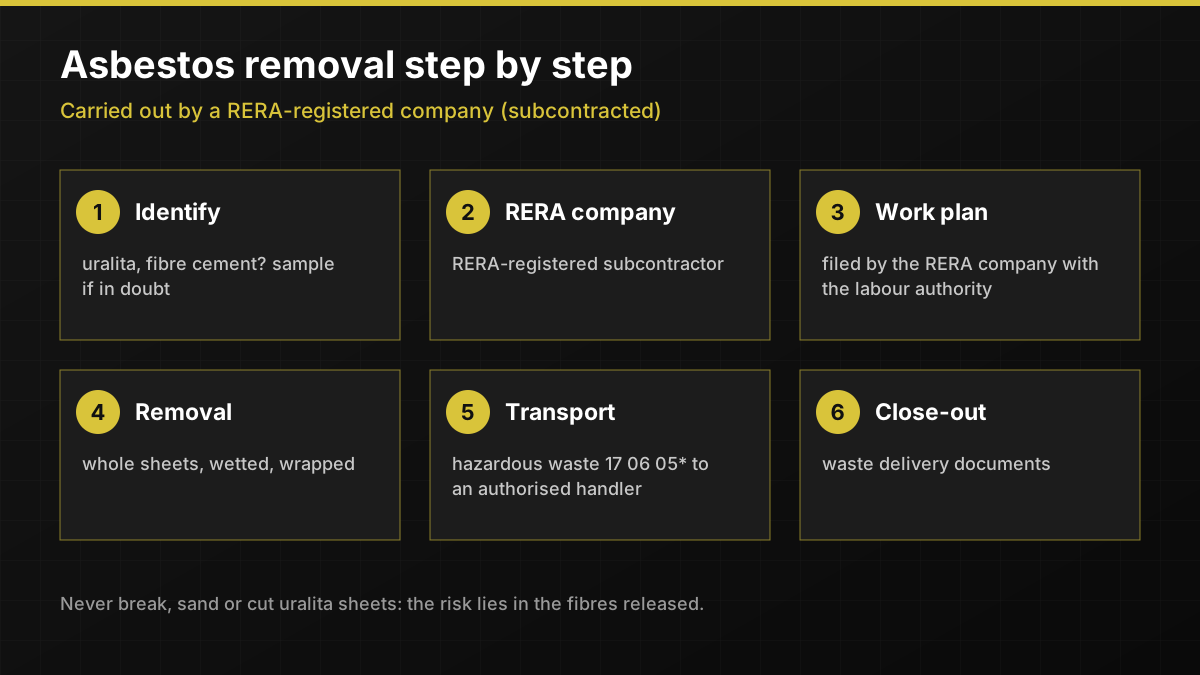
Under Real Decreto 847/2026, the removal or demolition of asbestos-containing materials in Spain is reserved for companies registered in the RERA working under a plan de trabajo approved by the provincial labour authority. Doing it yourself also leaves you without a legal route for the hazardous waste (17 06 05*). What an owner can do is identify the material, avoid disturbing it, gather information for quotes and let a registered company carry out the removal.
Contents
- The short answer: who may remove asbestos in Spain
- DIY versus a registered company, side by side
- The risks people underestimate
- The waste problem that DIY cannot solve
- What an owner can usefully do
- What about small pieces, tanks and pipes?
- Why 'I will be careful' is not a method
- How we fit into the picture
- Frequently asked questions
The short answer: who may remove asbestos in Spain
The rule that frames this question is Real Decreto 847/2026, de 21 de octubre, which set the minimum health and safety requirements for work with exposure to asbestos and repealed the old Real Decreto 396/2006. Under it, only companies registered in the RERA may demolish or remove materials containing asbestos, and only under a plan de trabajo approved by the labour authority of the province where the work takes place.
That is the legal framework. Beyond it, there is a practical one: a DIY removal leaves you with no approved plan, no protective system, no separate transport and no authorised destination for the waste. Each of those gaps is a problem of its own.
DIY versus a registered company, side by side
| Aspect | Doing it yourself | RERA-registered company |
|---|---|---|
| Legal basis | Not covered by the asbestos work system | Registered in the RERA, approved plan de trabajo |
| Method | Improvised; sheets often break | Wetting, fixings removed, whole sheets lowered and wrapped |
| Protection | Whatever you can buy in a DIY store | Protective equipment and procedures set in the plan |
| Fall risk | High: fibre-cement does not carry body weight | Edge protection, boards, lines or platforms |
| Waste | No authorised route for 17 06 05* | Separate transport, delivery to an authorised manager, documents |
| Paper trail | None | Work plan and waste delivery documents for your file |
The table is not about convenience; it is about whether the job can be done properly at all without the structure a registered company brings.
The risks people underestimate
Three risks surprise DIY enthusiasts most often:
- Falling through the roof. Asbestos cement sheets look solid but crack under a person's weight. Falls through fragile roofs are a well-known cause of serious accidents in construction, which is why professional crews never walk directly on the sheets.
- Breakage multiplies the problem. A sheet that cracks while you lever it off is no longer one piece of hazardous material but dozens, with fragments in gutters, the garden and the trailer.
- Contaminating your own space. Clothes, tools, the car used to carry the sheets: without decontamination procedures, the dust goes wherever you go.
None of these is visible at the moment of decision, which is why the job looks easier than it is.
The waste problem that DIY cannot solve
Even if the sheets came down intact, you would still have a pile of hazardous waste. Asbestos cement is classified as 17 06 05* – construction materials containing asbestos, and Ley 7/2022 (art. 30.1) requires asbestos to be handled safely and never mixed with other waste.
In practice that means it cannot go into a builders' skip with ordinary rubble, cannot be left at a recycling point for household waste and cannot be buried on the plot. It must be packaged and delivered to an authorised manager, with documents. A registered company organises that route as part of the job; an individual on a Saturday morning has no such access. Our guide on asbestos waste disposal in Spain describes the route in detail.
What an owner can usefully do
There is a real role for the owner, and doing it well saves time and money:
- Identify where asbestos cement may be: roofs, tanks, downpipes, flues, buried pipes. Our guide on recognising uralita helps without touching anything.
- Stop anyone disturbing it: no drilling, cutting, pressure-washing or walking on it.
- Photograph and measure from a safe position: overall views, close-ups, the access from the street.
- Decide what comes next: new roof, demolition of the structure, or just removal.
- Collect quotes that name the RERA company and include the work plan and the waste route.
With that preparation, a quote for uralita roof removal can be issued from photos, even if you are not in Spain.
What about small pieces, tanks and pipes?
Owners often assume that a single cracked downpipe or a small water tank is too minor to count. The rule in Real Decreto 847/2026 refers to asbestos-containing materials, not to large roofs only, so the same logic applies: the removal belongs with a RERA-registered company and the waste follows the hazardous route.
Small elements are actually a good reason to group work. If you have an old tank on the roof, a downpipe on the façade and a short run of buried pipe, they can be removed together in one planned job. Our page on asbestos pipes and fibre-cement water tanks explains how that is usually organised.
Why 'I will be careful' is not a method
Most owners who consider doing it themselves are not careless; they intend to wet the sheets, wear a mask and go slowly. The trouble is that care without a plan leaves the key questions unanswered. Where does the wash water go? How are whole sheets lowered from a height without a second person on a platform? Where do the wrapped sheets wait, and who takes them away? What happens to the clothes and the tools at the end of the day?
A plan de trabajo exists precisely to answer those questions for a specific site before the first fixing is touched. That is the real gap between good intentions and a regulated removal.
How we fit into the picture
Retirada de Uralita Málaga is not a RERA-registered company. The asbestos removal is carried out by a company registered in the RERA that works as our subcontractor; it prepares and files the plan de trabajo and executes the removal. We coordinate the rest: the demolition of whatever structure remains, sorting of ordinary rubble, waste receipts and the timing with your técnico or your next builder.
That split is what most owners actually need: one point of contact for the whole job, with the asbestos part done by the people legally entitled to do it. If the asbestos sits inside a bigger demolition, our asbestos removal before a demolition service shows the sequence, and Demoliciones Málaga covers the demolition of houses and villas that often follows. Before choosing anyone, go through the red flags post.
Sources
Frequently asked questions
Can a private owner legally remove an uralita roof in Spain?
Real Decreto 847/2026 reserves the removal and demolition of asbestos-containing materials for RERA-registered companies working under an approved plan de trabajo, so this is not a DIY job.
Does the rule apply to a single sheet or a small tank?
The rule refers to asbestos-containing materials in general, not only to large roofs. Small elements follow the same route and are best grouped into one planned job.
Can I take asbestos sheets to the municipal recycling point?
Asbestos cement is hazardous waste (17 06 05*) that may not be mixed with other waste; it goes to an authorised manager through the registered company.
Can I bury old uralita sheets on my land?
No. Asbestos waste has to be packaged and delivered to an authorised manager; burying it is not a legal disposal route.
Is it safe to walk on an uralita roof to inspect it?
No. Fibre-cement sheets break under a person's weight; inspect from the ground, a window or a safe platform.
Can I at least unscrew the sheets and leave them for the company?
No. Removing fixings is part of the removal itself and belongs within the registered company's work plan.
What protective equipment would I need?
That is defined by the work plan of a registered company, which is precisely why the job is not suitable for an individual.
Is Real Decreto 396/2006 still valid?
No. It was repealed by Real Decreto 847/2026, in force since late October 2026.
What can I do myself before calling a company?
Identify the elements, keep people away from them, take photos and measurements from a safe position and decide what should happen afterwards.
Are you the RERA company that would remove it?
No. A RERA-registered company works as our subcontractor for the asbestos part; we coordinate the rest of the job.
Can a builder remove the uralita as part of a renovation?
Only if the asbestos part is done by a RERA-registered company under an approved plan; the builder can carry on once it is gone.