
In short
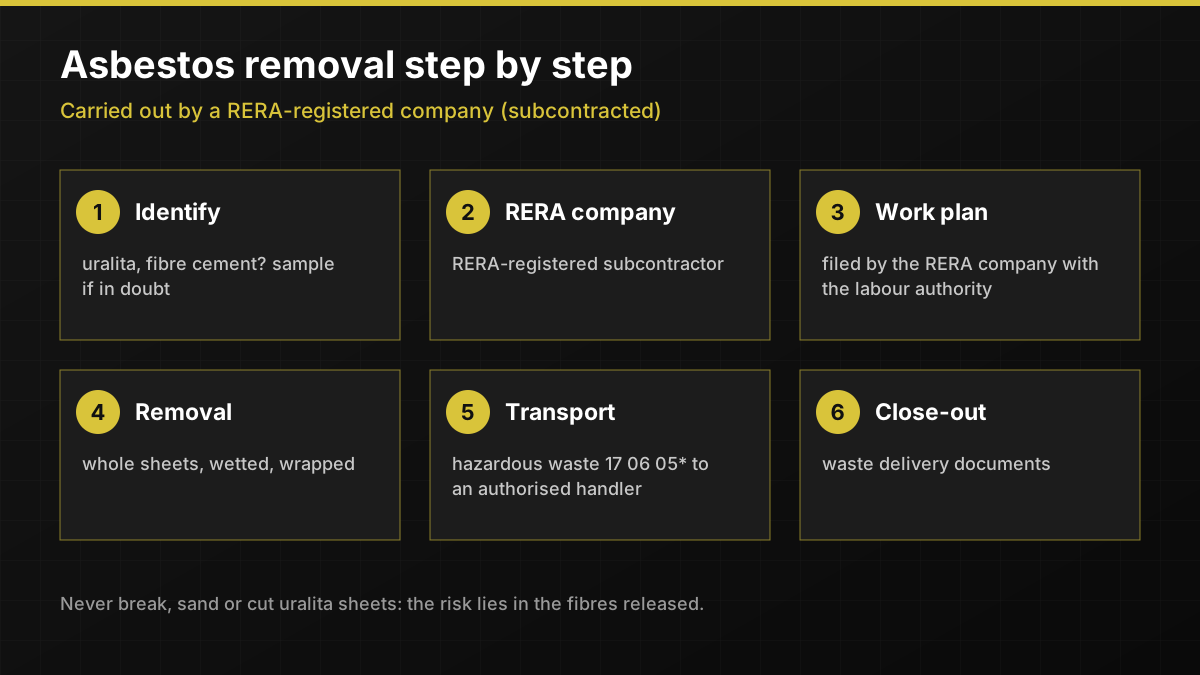
Uralita removal means taking every asbestos cement element off a property – roofs, tanks, pipes, flues – in a single planned job. A RERA-registered company working as our subcontractor removes the material under its approved work plan; we are your single contact, in English, and carry out the demolition, rubble removal and clean-up around it.
Contents
- What does uralita removal involve on a typical property?
- Uralita removal for overseas owners: how it works remotely
- Villas, apartments and fincas: three different jobs
- Before selling or buying a property with uralita
- Who is allowed to do the work in Andalusia?
- What happens after the uralita has gone
- What determines the cost of removing all the uralita?
- Frequently asked questions
What does uralita removal involve on a typical property?
Uralita removal is the planned removal of every asbestos cement element on a property by a RERA-registered company, followed by whatever demolition and clean-up the owner needs. On a typical older villa or finca in the province of Málaga, the list looks something like this:
- the roof of the garage, carport, porch or pool house;
- a water tank on the roof or in the loft, sometimes two;
- downpipes and a flue on the façade;
- a shed or pump house roof at the bottom of the plot;
- sections of buried pipe that appear whenever someone digs.
It is common for an owner to know about the garage roof and nothing else. That is why the first step is a walk round the whole plot – by you, your key holder or us – looking at every roof, the top of each flat roof, the façades and the outbuildings, so that the work plan covers everything that is there rather than only the obvious item.
Dealing with them one by one means repeated visits, several work plans and more disruption. Grouping them into a single job is usually simpler for everyone. The individual elements are covered in detail on our pages about uralita roofs and pipes and tanks.
Uralita removal for overseas owners: how it works remotely
Many of the owners we work with live in another country and visit a few times a year. The uralita removal process is designed so that you do not need to be present:
- You send photos of the elements you know about; we tell you what else to look for and ask your key holder or gardener to take more pictures if needed.
- We agree access once, and tell you in advance each time anyone will be on the property.
- The RERA-registered subcontractor visits, prepares its work plan and files it with the provincial labour authority.
- You receive photos before, during and after each phase by WhatsApp or e-mail.
- At the end, the waste delivery receipts are sent to you by e-mail.
For municipal and tax paperwork related to the works, the owner identifies with their DNI, NIE or NIF. If you are planning more than removing the uralita, our sister site explains how to manage a demolition from abroad.
Villas, apartments and fincas: three different jobs
Villas on the coast usually have uralita on garages, porches and pool houses rather than on the main house, plus tanks and flues. Access is generally good, but neighbours are close and gardens need protecting.
Apartments rarely have uralita inside the flat itself; it is on the shared roof, in shafts or in storage rooms. Here the community decides, as explained on our page about asbestos in communities of owners.
Fincas and cortijos inland often have the most: animal sheds, stores, old water deposits and buried mains. Access tracks, distance and the state of the outbuildings shape the plan, and part of the work may be demolishing structures that are no longer worth keeping. For large agricultural buildings, see asbestos in warehouses and farm buildings.
Before selling or buying a property with uralita
Uralita is increasingly a topic in property sales on the Costa del Sol. Buyers' surveyors mention it, buyers ask about it, and some negotiate the price around it. As a seller, removing it before marketing the property gives you one less thing to discuss; as a buyer, knowing what is there and what removing it involves lets you plan rather than be surprised.
Our post on what buyers wish they had known about uralita collects the most common lessons, and common concerns before an asbestos removal in Spain answers the practical worries – noise, neighbours, dust, timing – that come up before the work starts.
Who is allowed to do the work in Andalusia?
Only companies registered in the RERA may demolish or remove asbestos-containing materials, under a work plan approved by the labour authority of the province where the work is done. In Andalusia the register is kept by the Junta de Andalucía. The rules are set by Real Decreto 847/2026, in force since late October 2026; the old Real Decreto 396/2006 is no longer in force.
The asbestos removal on our jobs is carried out by a RERA-registered company working as our subcontractor, which prepares and files its own work plan. We coordinate that phase and do the rest of the demolition. If you are comparing offers, the guide on the RERA register explains what to ask, and the post on red flags with contractors without RERA registration lists the warning signs.
What happens after the uralita has gone
When the last fibre-cement element has been taken away as hazardous waste, the property moves on to its next stage. Roofs are replaced by your roofer, tanks by your plumber, and structures that are no longer needed are demolished by our team. All remaining rubble is sorted on site and taken to authorised facilities, and you receive the delivery receipts.
If the plan includes knocking down interior walls or stripping out a kitchen or bathroom at the same time, our sister site Demolición Interior Málaga covers that work. The guide on replacing an uralita roof helps you choose the new cover.
What determines the cost of removing all the uralita?
The total depends on how many elements there are, their size and height, their condition, how vehicles reach the property, and how much demolition and rubble removal follow. Grouping all elements in one job tends to be more efficient than calling several times, because the work plan, access equipment and transport are organised once.
We do not publish prices on this site. Our sister site explains asbestos removal costs factor by factor, and when you are ready, the contact page tells you what to send for a no-obligation quote.
Frequently asked questions
What is the difference between uralita removal and asbestos removal?
In everyday Spanish, uralita means fibre-cement, much of it containing asbestos. Uralita removal is about these fibre-cement elements; asbestos removal also covers other asbestos materials found during a demolition.
Can you remove uralita while I am in the UK?
Yes. We agree access once, send you photos of each phase and e-mail you the documents at the end.
Do you handle uralita removal for apartments?
Yes, usually on the shared roof, in shafts or storage rooms, which means the community of owners has to agree the work.
Who actually removes the uralita?
A RERA-registered company working as our subcontractor, under its own work plan approved by the labour authority of Málaga province.
Can all the elements be removed in one visit?
Often yes, if they are included in the same work plan. Large fincas may be done in phases.
Should I remove the uralita before selling?
It is not legally required by a fixed date, but many sellers do it to avoid questions from buyers' surveyors and price negotiations.
I am buying a villa with an uralita garage roof. What should I do?
Photograph every fibre-cement element, include them in your planning and ask for an assessment before the price is final.
Do I need a NIE to have the work done?
For municipal and tax paperwork related to the works, the owner identifies with their DNI, NIE or NIF.
Can the gardener or caretaker help?
Yes, with access and photos. They must not touch, cut or move the fibre-cement elements.
What happens to the rest of the rubble?
It is sorted on site into separate fractions, taken to authorised facilities and documented with delivery receipts.
Do you work across the whole province?
Yes, from the Costa del Sol to the Serranía de Ronda, the Axarquía and the Antequera area.