In short
The RERA (Registro de Empresas con Riesgo por Amianto) is the official register of companies that carry out work with a risk of asbestos exposure. Only RERA-registered companies may demolish or remove asbestos-containing materials, and only under a work plan approved by the labour authority of the province. In Andalusia the register is kept by the Junta de Andalucía, and owners should ask any contractor which registered company will do the removal.
Contents
- What is the RERA?
- Who has to be registered, and who does not?
- What does registration allow a company to do?
- Why does the RERA matter so much for owners?
- How can you check a contractor's RERA status?
- What the RERA does not cover
- Red flags when the RERA is not mentioned
- How we work with a RERA-registered subcontractor
- Frequently asked questions
What is the RERA?
RERA stands for Registro de Empresas con Riesgo por Amianto, the register of companies whose work involves a risk of asbestos exposure. A company that wants to demolish or remove materials containing asbestos has to be entered in it. The register exists so that the labour authorities know which companies do this work and can supervise how they do it.
The rules on work with asbestos are now contained in Real Decreto 847/2026, in force since late October 2026, which replaced Real Decreto 396/2006. The core principle owners need to retain did not change with the new decree: asbestos removal is restricted work, reserved to registered companies operating under approved plans.
In Andalusia the register is kept by the Junta de Andalucía. Its published leaflet on asbestos removal companies is a good plain-language starting point and is listed among the sources of this guide.
A useful way to think about it: the RERA answers the question «who may do this work?», while the work plan answers «how will this particular job be done?». Owners who keep both questions in mind rarely end up with an improvised removal. Those who ask neither are the ones who later discover broken sheets in a skip, an unhappy community or a buyer's surveyor asking for papers that do not exist.
Who has to be registered, and who does not?
The obligation falls on the company that physically carries out the demolition or removal of asbestos-containing materials. It is not a register of owners, buildings or architects, and it is not a register of every builder who works near asbestos.
This matters because many jobs involve more than one company. In a typical villa project on the Costa del Sol, the parties might be:
| Party | Role in the asbestos phase | RERA registration |
|---|---|---|
| Owner (promotor) | Commissions the work, provides access and information | Not applicable |
| Técnico competente | Prepares the technical documentation of the demolition | Not applicable |
| RERA-registered company | Prepares and files the work plan, removes the asbestos | Required |
| Demolition contractor | Carries out the rest of the demolition and rubble removal | Only if it removes asbestos itself |
On our jobs the last two rows are separate companies. We are not registered in the RERA. The removal of asbestos is carried out by a company registered in the RERA working as our subcontractor, and we coordinate the rest of the demolition. That arrangement is legitimate precisely because the asbestos is handled by the registered company under its own approved work plan.
What does registration allow a company to do?
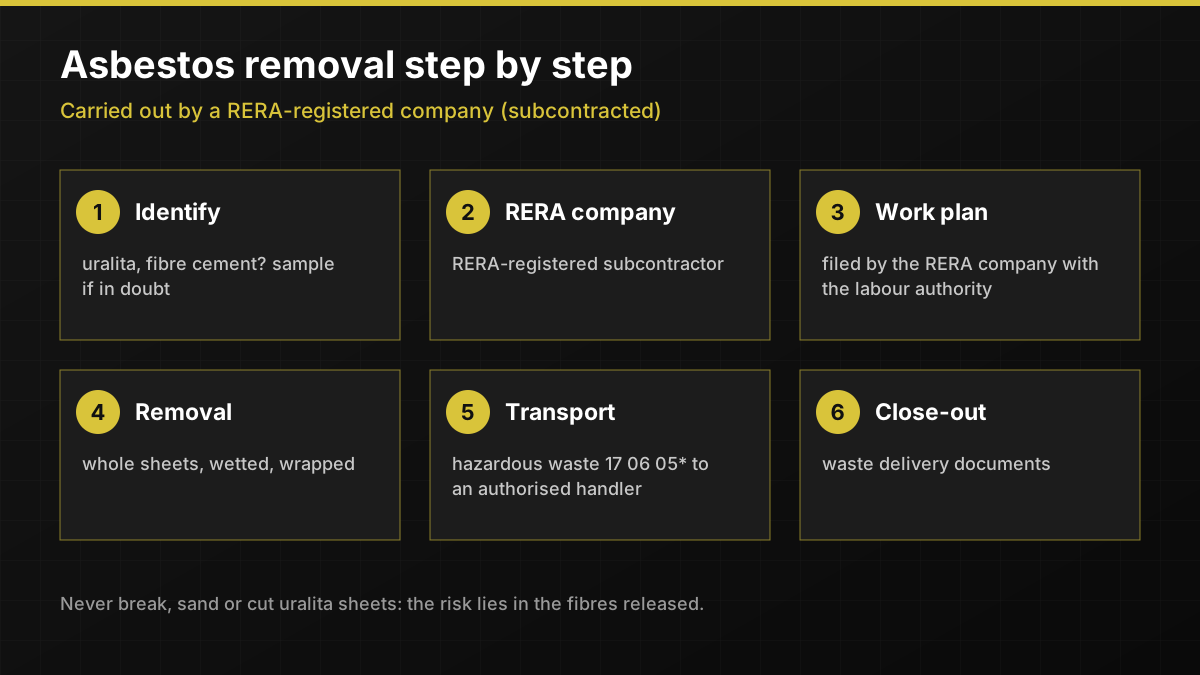
Registration is a precondition, not a blank cheque. Being in the RERA allows a company to carry out asbestos removal work, but each job still has to go through its own plan de trabajo, approved by the labour authority of the province where the work takes place, with the start of works notified in advance.
So when you hire for an asbestos job, two questions belong together: Is the company registered? and Will there be an approved work plan for my property? A yes to the first without the second is not enough. Our guide to the asbestos work plan and who approves it covers the second question in detail.
Registration also does not turn the RERA company into the manager of your whole project. Its scope is the asbestos phase. Demolition permits, the técnico's documentation, the conventional demolition and the clearance of the site are separate pieces of the job.
Why does the RERA matter so much for owners?
For an owner, the RERA is mostly about protection from bad decisions made on your behalf. Several practical reasons stand out:
- Health: registered companies work under procedures designed to limit fibre release, for their workers and for the people around the site.
- Paperwork: an approved plan and a documented waste route leave a trail you can show to a buyer, a community or the town hall.
- Waste: asbestos waste is hazardous (LER 17 06 05*) and, under Ley 7/2022, may not be mixed with other waste; a registered company organises its separate packaging and delivery to an authorised manager.
- Your project timetable: a removal done outside the system can stop a later demolition, renovation or sale while the situation is sorted out.
When you manage a house from abroad, this paper trail is often the only evidence you have that the job was done properly. Ask for it from the beginning rather than trying to reconstruct it afterwards.
How can you check a contractor's RERA status?
Checking takes a few minutes and is worth doing for every asbestos job, whoever introduced the contractor to you:
- Ask in writing which company will physically remove the asbestos. If it is a subcontractor, ask for its name.
- Ask for its RERA registration details and the autonomous community where it is registered.
- Ask whether a work plan will be filed for your property and with which provincial labour authority.
- Compare names: the company on the plan should be the company on site.
- Ask what documents you will receive at the end, including the proof that asbestos waste reached an authorised manager.
We encourage owners to make these checks with us too. We do not name our partner in public material, but for a concrete job the owner deals with a clearly identified registered company for the asbestos phase.
What the RERA does not cover
Owners sometimes expect the RERA company to take care of everything connected with the property. Its role is narrower, and knowing the limits avoids gaps in the project.
- Demolition permits. Whether the demolition goes through a declaración responsable or a licencia urbanística is an urban-planning question for the owner and their técnico with the ayuntamiento. Our sister site explains the Andalusian rules in its guide to demolition permits in Andalusia.
- Technical documentation. The proyecto or memoria técnica, the estudio de seguridad y salud and the estudio de gestión de residuos are drafted and signed by a técnico competente.
- Non-asbestos waste. Concrete, bricks, tiles, timber and metal from the rest of the job follow their own sorting and delivery route, organised by the demolition contractor.
- Replacement works. A new roof, a new tank or new plumbing is a separate trade and a separate decision.
- Occupation of the street. If a container or scaffolding has to stand on the public road, authorisation for occupying the vía pública is needed.
The point is not that these tasks are less important, but that they belong to someone else. A well-run job names who is responsible for each one before work starts, so that nothing is left to the last minute.
Red flags when the RERA is not mentioned
Some offers sound convenient and are best avoided. Be cautious when:
- a builder, gardener or handyman offers to take down an uralita roof as a small extra on another job;
- nobody mentions a work plan, or you are told it «isn't needed for something this small»;
- the quote says nothing about how the asbestos waste will be packaged and where it will go;
- you are invited to put broken sheets in a skip with the rest of the rubble;
- the person asks you to keep the job quiet from the community or the neighbours.
How we work with a RERA-registered subcontractor
We organise asbestos jobs in the provincia de Málaga around a clear division of tasks. The registered company assesses the asbestos elements, prepares and files the plan de trabajo, carries out the removal and arranges the separate route for the asbestos waste. We coordinate dates, access and the order of works, and then carry out what follows: demolition of the structure, sorting of the other materials and removal of the rubble.
This structure suits owners who want one point of contact for the whole job. Typical cases are a garage roof on a villa, covered on our uralita removal page, an older building that has to come down, covered under asbestos removal before demolition, or a shared roof or tank in a block, covered under asbestos in communities of owners.
If you are comparing offers, our sister site's guide on how to compare demolition quotes helps you line up what each company actually includes.
Sources
Frequently asked questions
What does RERA stand for?
Registro de Empresas con Riesgo por Amianto: the Spanish register of companies whose work involves a risk of asbestos exposure.
Who keeps the RERA in Andalusia?
The Junta de Andalucía. Work plans for jobs in the provincia de Málaga are approved by the labour authority of that province.
Is your company registered in the RERA?
No. On our jobs the asbestos removal is carried out by a RERA-registered company working as our subcontractor, and we coordinate the rest of the demolition.
Can a builder without RERA registration remove uralita?
No. Only RERA-registered companies may demolish or remove asbestos-containing materials, under an approved work plan.
Is RERA registration enough on its own?
No. Each job also needs its own work plan approved by the provincial labour authority before the removal is carried out.
Does the owner need to be registered?
No. The register applies to the companies that carry out the work, not to owners or buildings.
Does the RERA rule apply to a single sheet or tank?
Yes. Any removal of asbestos-containing material falls to a registered company, whatever the size of the job.
Which law sets the RERA rules today?
Real Decreto 847/2026, in force since late October 2026, which replaced Real Decreto 396/2006.
How do I check whether a company is registered?
Ask in writing for the name of the company that will remove the asbestos, its RERA registration details and the authority with which the work plan will be filed.
Can I hire a RERA company directly instead of through you?
Of course. Our arrangement makes sense when asbestos removal is part of a wider demolition or clearance and you want one coordinator for the whole job.
What happens to asbestos waste after removal?
It is packaged separately, never mixed with other waste, and delivered to an authorised manager as LER 17 06 05*.