In short
When asbestos cement is part of a common element – a shared roof, rooftop tank, downpipe or storeroom – the community of owners decides on its removal: under Ley 49/1960 the community must be informed and works affecting common elements need the owners' meeting agreement. How the cost is shared follows the community's own rules and title, which the administrador de fincas can explain. The removal itself is carried out by a RERA-registered company under an approved work plan.
Contents
- Is the asbestos in a common element or in your property?
- Who has to be informed, and who has to agree?
- Who pays for removing asbestos from a shared element?
- How should the community prepare the decision?
- How is the removal carried out in an inhabited building?
- Which objections come up in owners' meetings?
- What if a single owner discovers asbestos during a renovation?
- How we help communities of owners
- Frequently asked questions
Is the asbestos in a common element or in your property?
The first question is not technical but legal: does the element belong to the community or to you? The answer decides who takes the decision.
In most buildings under propiedad horizontal, the roof, the structure, the façades, the shared installations and the main downpipes are common elements. Some elements are less obvious: a storeroom roof used only by one owner, a tank serving a single flat, a carport on a private plot inside an urbanización. Whether those are private, common or common with exclusive use depends on the title deed of the building, its statutes and the description of each property.
So before you call anyone to remove an uralita roof over «your» terrace, ask the administrador de fincas to check the documents. It is a short conversation that avoids a long dispute.
In townhouse urbanizaciones the picture can be mixed: each house may own its own roof, while the community owns the roofs of shared garages, pool plant rooms or the caretaker's building. The same logic applies – identify the owner of each element first, then decide.
Who has to be informed, and who has to agree?
The rule we rely on comes from Ley 49/1960 de Propiedad Horizontal: before demolishing walls, structure or façade elements in a building under propiedad horizontal, the community must be informed, and works affecting common elements need the agreement of the junta de propietarios (owners' meeting).
In practice that means:
- Common element: the matter goes to the owners' meeting, normally prepared by the president and the administrador de fincas.
- Private element touching common parts: you inform the community and, where common elements are affected, obtain its agreement before works.
- Purely private element: you decide, but it is still good practice to inform neighbours about dates, access and the presence of an asbestos removal team.
We do not give advice on majorities or voting thresholds; they depend on the type of decision, and the administrador de fincas is the right person to explain them for your building.
Who pays for removing asbestos from a shared element?
For common elements, the cost is a community expense, and how it is distributed among owners follows the community's own rules – normally the participation quotas in the title and any specific provisions in the statutes. Those rules vary from building to building, which is why we do not give a general answer.
What we can say is how to make the decision easier for the meeting:
- A clear scope: which elements, approximate quantities, access and what replaces them.
- A breakdown: the asbestos phase by the RERA company, any demolition or clearing around it, and the replacement works by the relevant trades.
- Comparable offers: quotes that cover the same items, so owners compare like with like.
The factors that drive the price – quantity, height, access, type of element and the waste route – are explained without amounts on our sister site's asbestos removal cost page, which you can share with the other owners.
How should the community prepare the decision?
Owners' meetings work best when the information arrives before the meeting, not during it. A good preparation sequence is:
- Identify the elements. List and photograph suspect roofs, tanks, downpipes, flues and panels in common areas. Our guide on recognising uralita helps with that.
- Request an assessment. A RERA-registered company assesses the elements and how they could be removed; on our jobs it works as our subcontractor.
- Collect offers that separate the asbestos phase from the rest of the work and the replacement.
- Circulate the documents to all owners with the call to the meeting, in English as well as Spanish if many owners are foreign.
- Decide in the meeting and record the agreement in the minutes.
- Organise the works: dates, access, notice to residents, protection of common areas.
Many communities on the Costa del Sol have a large share of non-resident owners. Clear written material in both languages, with photos, is often what makes the difference between a postponed item and an approved one.
How is the removal carried out in an inhabited building?
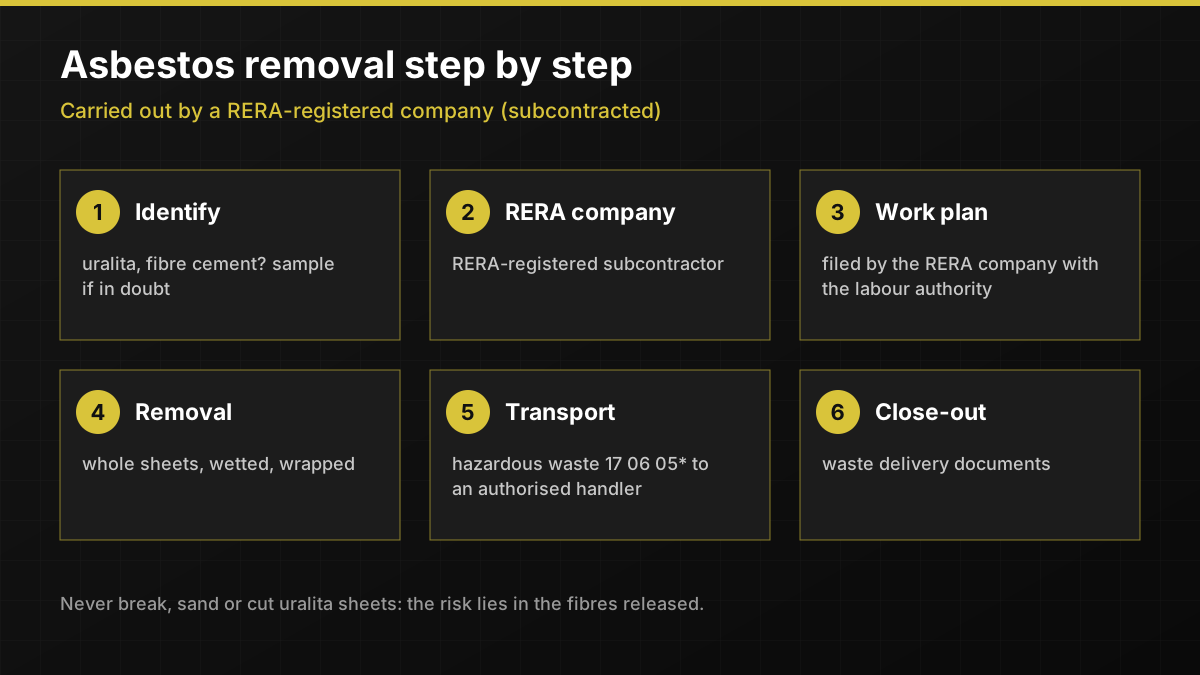
The asbestos phase is carried out by a company registered in the RERA, under a work plan approved by the labour authority of the provincia de Málaga, now under Real Decreto 847/2026. The plan covers the specific site, so the presence of residents, the access through common areas and the protection of neighbouring flats are part of what the RERA company has to organise.
For the community the practical points are:
- notice to residents about dates, working hours and any areas that will be closed;
- a key-holder or the caretaker to open the roof, plant rooms and storerooms;
- parking or loading space for the vehicle that takes the packaged waste;
- authorisation for occupying the public road if a container, lifting equipment or scaffolding stands in the street;
- coordination with the maintenance company if tanks or downpipes must be disconnected first.
When several companies work in the building at the same time, Real Decreto 1627/1997 requires the promotor – here the community – to appoint a coordinador de seguridad y salud during execution. Our sister site summarises these rules in its guide to health and safety on a Spanish demolition site.
Which objections come up in owners' meetings?
Asbestos items on the agenda tend to raise the same questions. Preparing answers in advance keeps the meeting focused.
«It has been there for decades without problems.» True, and asbestos cement in good condition that nobody touches is generally stable. The case for removal is usually about deterioration, leaks, planned works on the roof or façade, or the effect on sales of flats, not about a sudden emergency.
«Is it legally compulsory now?» In the rules we rely on, there is no fixed date by which private owners must remove asbestos. Ley 7/2022 obliged town halls to draw up a census and set goals for higher-risk public buildings; our guide on municipal asbestos inventories explains what that means.
«Can't the maintenance company just do it?» Only if it is registered in the RERA and works under an approved plan. Otherwise its role is to disconnect and later reconnect installations, not to remove the asbestos.
«Why not wait and do everything together later?» Combining the asbestos removal with planned roof, façade or plumbing works is often sensible. What owners should avoid is starting those works first and discovering mid-job that the asbestos phase has to be planned and approved before anything else can continue.
What if a single owner discovers asbestos during a renovation?
This is the most common way communities learn they have asbestos: an owner renovating a kitchen or bathroom opens a wall and finds a grey fibre-cement downpipe or flue. The right reaction is to stop work on that element, inform the president or administrador, and let the community decide on a joint solution for the shared installation.
Cutting out «just my section» of a shared downpipe is a bad idea twice over: it disturbs asbestos cement without a registered company and work plan, and it alters a common installation without the community's agreement. Both problems can come back at the owner later.
The renovation of the flat itself can usually continue around the affected element once it is protected and nobody touches it. Our guide on asbestos cement pipes and water tanks explains how pipe removals are typically sequenced with the plumbing works.
How we help communities of owners
For communities in the provincia de Málaga we organise the job as a coordinated package: the removal of asbestos cement by a RERA-registered company working as our subcontractor, and the associated demolition, clearing and rubble removal by us. The replacement roof, tanks or pipes are installed by the trades the community chooses, with dates coordinated.
We can work with the administrador de fincas as the main contact and send updates with photos to owners who live abroad. Typical jobs include roofs of storerooms and plant rooms, see uralita roof removal; rooftop tanks and shared downpipes, see asbestos pipes and tanks; and building-wide projects, see asbestos in communities of owners.
Send the administrador's contact, the address and photos of the elements, and we will explain without obligation how the work would be organised for your building.
Sources
Frequently asked questions
Who decides on removing asbestos from a shared roof?
The community of owners: works affecting common elements need the agreement of the owners' meeting under Ley 49/1960 de Propiedad Horizontal.
Can I remove the uralita over my own terrace without asking?
Only if it is genuinely a private element. Check the title and statutes with the administrador de fincas first, and inform the community if common parts are affected.
Who pays for removing asbestos from common elements?
It is a community expense distributed according to the community's own rules, normally the participation quotas in the title. The administrador can explain how it applies in your building.
Which majority is needed in the owners' meeting?
That depends on the type of decision and the building; we do not advise on majorities. Ask your administrador de fincas.
Does the community need a RERA company?
Yes. Any removal of asbestos-containing materials is carried out by a RERA-registered company under an approved work plan; on our jobs that company is our subcontractor.
Do residents have to leave the building during the works?
The RERA company's work plan sets out how the area is organised and protected; the community should give residents notice of dates and any closed areas.
I found a fibre-cement downpipe while renovating my flat. What now?
Stop work on that element, protect it, and inform the president or administrador so the community can plan a joint solution.
Is a safety coordinator needed?
When several companies work in the building, Real Decreto 1627/1997 requires the promotor to appoint a coordinador de seguridad y salud during execution.
Can you send information to non-resident owners in English?
Yes. We can provide scope descriptions and photo updates in English for owners who live abroad.
Do we need permission to put a container in the street?
Yes. If a container, lifting equipment or scaffolding stands on the public road, authorisation for occupying the vía pública is needed.