In short
Uralita is the name Spaniards use for fibre-cement products, and on older buildings it normally means asbestos cement: corrugated roof sheets, rooftop water tanks, downpipes, flues and buried pipes. You can suspect it from its look and the age of the building, but only a laboratory analysis of a professionally taken sample confirms it. If it is confirmed, removal is work for a RERA-registered company under an approved work plan.
Contents
- What does the word uralita actually mean?
- Where does uralita usually appear on Costa del Sol properties?
- What does asbestos cement look like?
- Does the age of the building tell you anything?
- How is asbestos confirmed?
- What should you not do if you suspect uralita?
- What happens if uralita is confirmed on your property?
- Frequently asked questions
What does the word uralita actually mean?
Uralita is a trade name that became a common noun. It belonged to a Spanish manufacturer of fibre-cement building products, and over the decades the brand name came to stand for the whole family of grey, cement-based sheets, tanks and pipes, whoever made them. When a neighbour, a builder or an estate agent in Andalusia says «el tejado es de uralita», they mean the roof is made of fibre-cement sheets.
The reason the word worries people is the material inside. Older fibre-cement was asbestos cement (in Spanish fibrocemento con amianto): a mix of cement and asbestos fibres that made thin sheets strong, light and cheap. Newer fibre-cement products are made without asbestos, so the word uralita alone does not prove anything. What matters is the age and origin of the specific piece on your property.
For practical purposes, an owner should treat any fibre-cement element on a building of a certain age as suspected asbestos until an analysis says otherwise. That is the attitude professionals take, and it is the one that keeps you from drilling, cutting or breaking something you should not touch.
Where does uralita usually appear on Costa del Sol properties?
On villas, cortijos, townhouses and small industrial units across the provincia de Málaga, asbestos cement turns up in a fairly predictable set of places. Walk round the property with this list:
- Roofs of secondary buildings: garages, carports, storerooms, laundry rooms, chicken sheds, stables, pump houses and pool plant rooms are the classic spots for corrugated grey sheets.
- Porches and terrace covers: lean-to roofs added to the side of a house, often resting on timber or steel beams.
- Rooftop water tanks: the square or round grey depósitos on flat roofs of older houses and apartment blocks.
- Downpipes and gutters: thick grey bajantes running down façades or hidden in service shafts.
- Chimney flues and vent pipes: grey tubes coming out of roofs from kitchens, boilers or fireplaces.
- Buried pipes: older irrigation, drainage or supply pipes on fincas and in gardens.
- Warehouses and farm buildings: large roofs and wall cladding on naves, workshops and agricultural stores.
- Less visible places: window boxes, planters, partition panels and old ducts, sometimes hidden behind later finishes.
The hidden cases are the ones that cause trouble during renovations. Our sister site covers them in its guide to hidden asbestos in interior renovations, which is worth reading before you open walls or ceilings.
What does asbestos cement look like?
Asbestos cement has a recognisable appearance, although none of these signs is proof on its own. Typical features are:
- Colour and surface: mid to dark grey, often weathered to a lighter, chalky tone, frequently covered with lichen, moss or black staining on roofs.
- Profile: wide, regular corrugations (the «big wave» look) on roofing, rather than the narrow ribs of metal sheet.
- Texture: slightly rough and matt; at broken edges you may see a fibrous, layered structure.
- Sound and weight: a dull knock, not the ring of metal; the sheets feel rigid and brittle rather than flexible.
- Markings: some sheets and tanks carry an embossed manufacturer name or code on the underside or edge.
Look from a distance, a ladder resting against a wall or the underside visible from inside a garage. Do not climb on a fibre-cement roof to inspect it: old sheets are fragile and can give way under a person's weight, which is a serious fall risk quite apart from the asbestos question.
| Material | How it usually differs from asbestos cement |
|---|---|
| Metal sheet (steel, aluminium) | Thin, rings when tapped, narrow ribs, may rust |
| Bitumen corrugated sheet | Soft, flexible, often green, red or black, lighter in weight |
| Polycarbonate or PVC | Translucent or plastic-looking, flexes easily |
| Modern asbestos-free fibre-cement | Can look almost identical – only analysis tells them apart |
Does the age of the building tell you anything?
Age is the strongest clue you have without a laboratory. Asbestos cement was a mainstream building product in Spain for decades, and the boom years of the Costa del Sol – when many of today's villas, urbanizaciones and rural annexes were built or extended – coincide with its widest use. A garage roof or rooftop tank that clearly dates from that period deserves to be treated as suspect.
Be careful with two assumptions. First, a «new» house is not necessarily free of asbestos: renovated properties often keep an old outbuilding, a buried pipe or a tank that nobody replaced. Second, an old house is not necessarily full of it: some owners already replaced roofs and tanks years ago. The escritura and the catastro tell you the age of the main building, but annexes were often added later and not always declared, so look at each element separately.
If you are buying, ask the seller directly whether any fibre-cement elements are on the plot and whether anything was removed before, and by whom. A clear answer, with papers if possible, is worth more than a guess.
How is asbestos confirmed?
The only reliable confirmation is a laboratory analysis of a sample. Appearance, age and markings narrow it down, but they cannot distinguish old asbestos cement from a modern asbestos-free sheet that looks the same.
Taking that sample means breaking off a small piece of material, which is precisely the action you want to avoid doing yourself. Leave it to a specialist who wets the material, seals the sample and repairs the point where it was taken. In many cases, when the age and look leave little doubt and the owner intends to remove the element anyway, the job is simply planned as asbestos removal from the outset: the RERA-registered company treats the material as asbestos cement and works accordingly.
What should you not do if you suspect uralita?
Asbestos cement in reasonable condition, left alone, is generally stable. The risk comes from releasing fibres, and that happens when the material is broken, cut, drilled, sanded or pressure-washed. Until it has been assessed:
- do not cut, drill or saw sheets, tanks or pipes, not even to fix a bracket or a satellite dish;
- do not clean a fibre-cement roof with a pressure washer or a stiff brush;
- do not walk on the roof or let gardeners, handymen or tenants do so;
- do not break up pieces and put them in a skip, a building-waste bag or the household bins;
- do not let a general builder remove it «quickly» as part of another job.
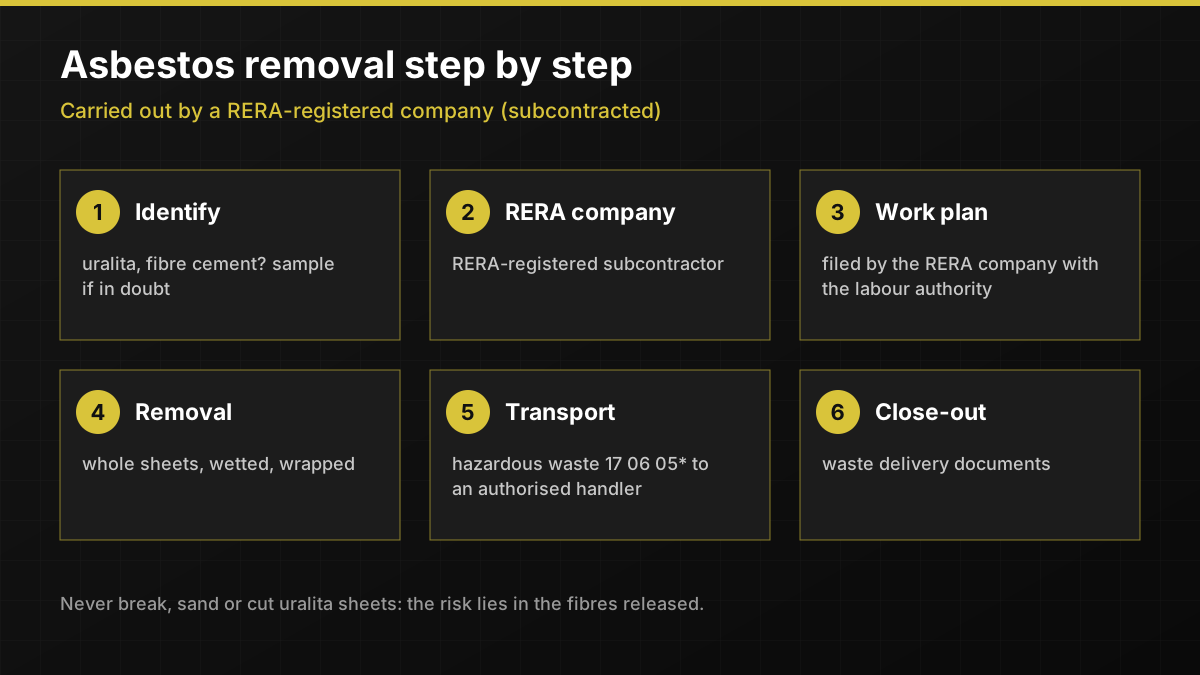
The legal position on removal is simple: only companies registered in the RERA may demolish or remove materials containing asbestos, and they do it under a work plan approved by the labour authority of the province where the work is carried out. This is now set by Real Decreto 847/2026, which replaced Real Decreto 396/2006 and is in force since late October 2026. Our guide on the RERA register explains what that registration means for you as an owner.
What happens if uralita is confirmed on your property?
Confirmation does not automatically mean you must remove it tomorrow. Our wording is deliberately cautious: there is no fixed date by which private owners must remove asbestos under the rules we rely on. What usually drives the decision is the condition of the material, a planned renovation or demolition, a sale, or simply the wish to get rid of the problem.
When you decide to remove it, the work is organised like this on our jobs: the asbestos removal is carried out by a company registered in the RERA working as our subcontractor, under its own approved work plan, and we coordinate the rest of the demolition, the clearing of the site and the other waste. Depending on what you have, the relevant pages are uralita roof removal, asbestos pipes and water tanks or the broader uralita removal service for villas and apartments.
If you live abroad, send photos of each suspect element from a few angles, a rough size, the municipio and a note on access. You can write to us in English, and the assessment is without obligation. For a first idea of what drives the budget, the price factors are on our sister site's asbestos removal cost page.
Sources
Frequently asked questions
Is uralita always asbestos?
No. Uralita is a generic word for fibre-cement, and newer fibre-cement is made without asbestos. On older buildings, however, it very often is asbestos cement, so treat it as suspect until analysed.
Can I tell asbestos cement apart just by looking?
You can suspect it from the grey colour, wide corrugations, chalky surface and the age of the element. Only a laboratory analysis of a sample confirms it.
Is it dangerous to live under an uralita roof?
Asbestos cement in reasonable condition that is left undisturbed is generally considered stable. The concern arises when it is broken, cut, drilled or badly weathered and fibres can be released.
Can I take a sample myself?
It is not advisable, because taking a sample means breaking the material. Leave it to a specialist who wets, seals and repairs the sampling point.
Where is uralita most often found on villas?
Typically on garage and storeroom roofs, porches, rooftop water tanks, downpipes, flues and buried garden or irrigation pipes.
Does a renovated house still have uralita?
It can. Renovations often leave an outbuilding roof, an old tank or a buried pipe in place, so check each element rather than the house as a whole.
Can I clean moss off an uralita roof with a pressure washer?
No. Pressure-washing or brushing asbestos cement wears the surface and can release fibres; have the roof assessed instead.
Who is allowed to remove uralita?
Only a company registered in the RERA, under a work plan approved by the provincial labour authority. On our jobs that company works as our subcontractor.
Do I have to remove uralita by law?
There is no fixed deadline for private owners in the rules we rely on. Removal is usually triggered by condition, renovation, demolition or a sale.
Can you assess my property if I live abroad?
Yes. Send clear photos, approximate sizes, the municipio and access details by e-mail or WhatsApp; you can write in English.
Should I ask about uralita before buying a property?
Yes. Ask the seller which fibre-cement elements exist, whether anything was removed and by whom, and request any papers from previous work.