
In short
In a community of owners, removing asbestos from common elements such as the roof, shared tanks or downpipes needs an agreement of the owners' meeting under the Ley de Propiedad Horizontal. The removal itself is done by a RERA-registered company working as our subcontractor; we prepare the information the administrator needs, coordinate access with residents and carry out the remaining works.
Contents
- Where asbestos usually hides in an apartment block
- Who decides: the owners' meeting and the administrator
- How the removal is organised in an occupied building
- Informing residents and owners who live abroad
- Shared tanks, private tanks and forgotten tanks
- The town hall census and what it means for a community
- Choosing the company: what the meeting should ask
- Frequently asked questions
Where asbestos usually hides in an apartment block
In older blocks and urbanisations on the Costa del Sol and in Málaga city, fibre-cement tends to appear in the same places: water tanks on the roof, downpipes in internal shafts or on the façade, ventilation and smoke ducts, the roofs of storage rooms and laundry areas on the top floor, and the covers of garages or bin stores. Some of these elements belong to the community, others to individual flats.
Before anyone talks about removal, it is worth making an inventory with photos: what is there, where it is, whether it is in use and what condition it is in. That list is what the administrator needs to put the subject on the agenda, and it avoids arguments later about what was or was not included.
Who decides: the owners' meeting and the administrator
Under the Ley de Propiedad Horizontal (Ley 49/1960), works that affect common elements – the roof, the façade, shared installations – need an agreement of the owners' meeting, and the community must be informed before walls, structure or façade elements are demolished. The exact majorities depend on the type of work; your administrator will tell you which applies.
In practice a job runs much more smoothly when the meeting has, in writing, a clear description of what will be removed, who will do the asbestos work and how the residents will be affected. Our guide on asbestos in a community of owners: who decides and who pays explains how to prepare that decision, and how the cost is usually shared according to the community's own statutes and quotas.
How the removal is organised in an occupied building
The asbestos removal is carried out by a company registered in the RERA that works as our subcontractor. It prepares its work plan, which the labour authority of the province approves, and the start of the work is notified in advance. The plan sets out how the work area is closed off and how the material is lowered to the street without crossing the flats.
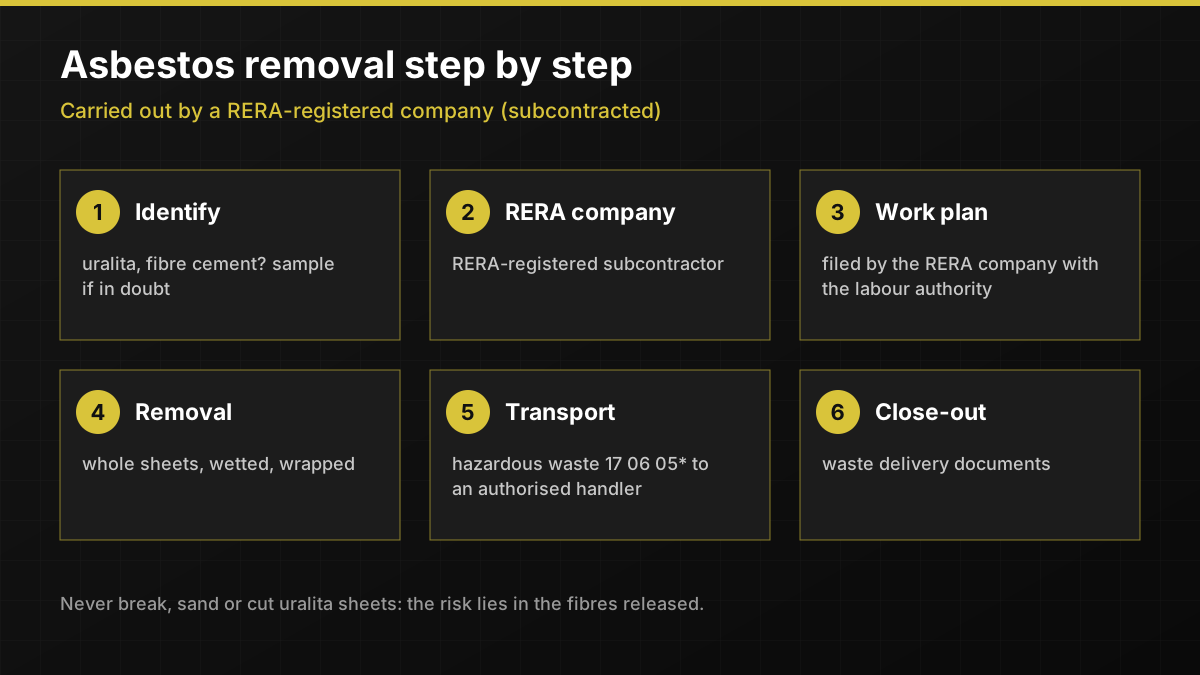
Our part is everything around it: coordinating dates with the administrator, informing residents, removing plinths and old supports once the fibre-cement is out, opening and closing small areas where pipes ran, and taking away the non-hazardous rubble. If a skip, lift or scaffold has to stand in the street, the town hall must authorise the occupation of the public road; the administrator or the community's technician usually applies for it.
Informing residents and owners who live abroad
Many communities on the coast have a high share of owners who are only there a few weeks a year. They want to know what is happening without having to fly over. We usually agree with the administrator a short written notice for the noticeboard and the owners' e-mail list, in Spanish and English, with the dates, the areas affected and a contact number.
- dates of each phase and which parts of the building will be closed;
- what residents should do – keep windows closed, avoid the roof, move items from storage rooms;
- photos of the finished work sent to the administrator for the community's records;
- the waste delivery receipts, for the community's file.
Lifts, stairwells and the street door are the points where residents and the work meet, so they get specific attention in the notice. Where the material has to come down through a shared space, the route and the hours are agreed with the administrator beforehand, and the area is cleaned when each day's work is finished.
This is the same approach we use with individual owners abroad, explained on our page about uralita removal for villas and apartments.
Shared tanks, private tanks and forgotten tanks
Water tanks are the most common asbestos item on community roofs. Some feed the whole building; others belonged to individual flats before mains pressure improved, and are now disconnected and forgotten. Removing disused tanks is usually the easiest item to approve, because nobody loses anything and the roof becomes safer and easier to maintain.
Where a private tank sits on a common roof, the community and the owner should agree beforehand who orders and pays for its removal. The practical details – disconnection, plinth, new supply – are explained on our page about asbestos pipes and water tanks and in the guide on what to do with asbestos cement pipes and tanks.
The town hall census and what it means for a community
Ley 7/2022 required town halls to draw up a census of installations and sites with asbestos, and higher-risk public buildings are to be dealt with before 2028. The law does not set a fixed date by which a private community must remove its asbestos, and owners should be wary of anyone who claims otherwise to win a contract.
The census is still a good reason to put the subject on the agenda: it keeps asbestos on the town hall's radar and buyers increasingly ask about it. Our guide on municipal asbestos inventories under Ley 7/2022 explains what the census is, and the post on who is legally required to remove asbestos in Spain answers the question that comes up at almost every meeting.
Choosing the company: what the meeting should ask
Owners' meetings sometimes receive several quotes that look similar on paper. Ask each bidder who will actually carry out the asbestos work, whether that company is registered in the RERA, who prepares and files the work plan and how the waste will be documented. A quote that does not mention a work plan is a warning sign.
Our post with an asbestos removal contractor checklist gives the meeting a ready-made list of questions. For the cost factors, our sister site's page on asbestos removal costs explains what makes one community job more expensive than another.
Frequently asked questions
Does the owners' meeting have to approve asbestos removal from the roof?
Yes. The roof is a common element, and works affecting common elements need an agreement of the owners' meeting under the Ley de Propiedad Horizontal.
Who pays for removing asbestos from common areas?
Normally the community, shared according to its statutes and each flat's quota. Your administrator can confirm how it applies in your building.
Can the community force me to remove my private tank on the roof?
That depends on the community's agreements and statutes. Talk to the administrator; it is usually best to agree who orders and pays before the job is planned.
Do residents have to leave their flats during the work?
Usually not. The work plan closes off the work area; residents may be asked to keep windows shut or avoid certain zones on given days.
Can you prepare information for our administrator?
Yes. We can provide a written description of what would be removed, how the work is split and how residents are affected, for the meeting.
Do you send updates in English?
Yes. Notices and photo updates can be sent in Spanish and English to the administrator and owners.
Is there a deadline for communities to remove asbestos?
No fixed date applies to private communities. Ley 7/2022 required town halls to draw up a census and set a 2028 horizon for higher-risk public buildings.
Who requests the permit for a skip or lift in the street?
The community, usually through its administrator or technician. We tell them what is normally needed and when.
What documents does the community receive at the end?
Photos of the finished work and the delivery receipts for the waste, for the community's records.
Can a maintenance company remove the old downpipes?
Not if they are asbestos cement. That work is reserved for RERA-registered companies with an approved work plan.
Can several items be done in one job?
Yes. Grouping roof, tanks and downpipes into one work plan usually reduces disruption and repeated access.