In short
Most worries before an asbestos removal in Spain come down to five things: fibre release during the work, the neighbours, the legal paperwork, managing the job from abroad and the fate of the waste. A RERA-registered company works under a plan de trabajo approved by the provincial labour authority, keeps asbestos waste separate as hazardous waste and documents its delivery to an authorised manager; we coordinate the rest of the job and keep you informed.

Contents
- Will the removal release fibres into my house and garden?
- Do I have to move out during the work?
- What will the neighbours say?
- Which permits and papers are involved?
- Can it all be done while I live abroad?
- How do I know the waste really goes where it should?
- How long does the whole process take?
- What happens to the building afterwards?
- Frequently asked questions
Will the removal release fibres into my house and garden?
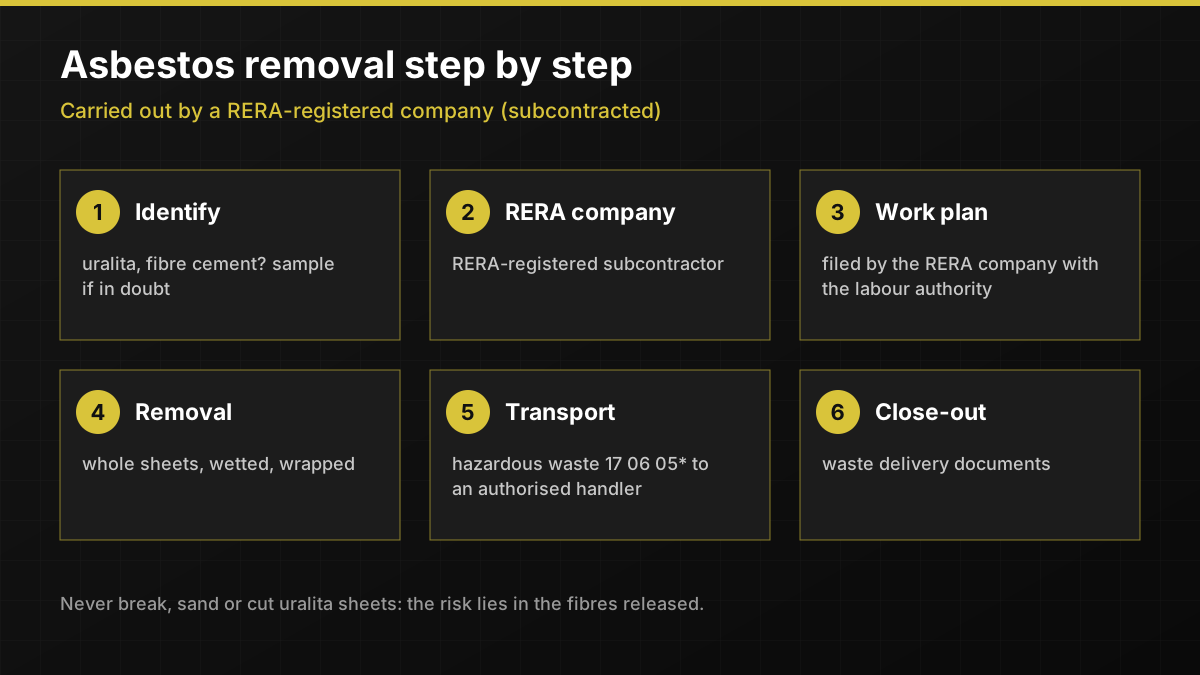
The purpose of the regulated method is precisely to keep fibre release to a minimum. Under Real Decreto 847/2026, the company doing the removal must be registered in the RERA and work under an approved plan de trabajo that sets out how the material is handled on that specific site.
In practice, for asbestos cement that usually means wetting the sheets, removing fixings rather than breaking the material, lowering whole pieces instead of throwing them down, wrapping them immediately and cleaning the work area at the end. The workers use protective equipment, and the zone is closed to anyone else while the work goes on.
What raises the risk is the opposite: smashing sheets, cutting them with a grinder or letting fragments fall into the garden. Those are exactly the practices described in our post on the best and worst ways to deal with old uralita.
Do I have to move out during the work?
For an outbuilding, a garage or a porch roof, owners and tenants can usually stay in the house, keeping windows on that side closed and staying out of the marked zone. For a roof directly over living space, or for interior elements, the RERA company's plan defines what areas must be vacated and for how long.
Ask the question early, especially if the property is a holiday let: it is easier to schedule the job between bookings than to explain a cordoned-off roof to guests. Pets and garden furniture near the work zone should also be moved beforehand.
What will the neighbours say?
Neighbours in urbanizaciones and villages often recognise protective suits and get worried. A short note or a word in advance – what is being removed, by whom, on which days – prevents most complaints. If the property belongs to a community of owners, there is a formal side as well: under Ley 49/1960 de Propiedad Horizontal, works affecting common elements need the owners' meeting agreement, and the community must be informed before structural or façade elements are touched.
Our page on asbestos removal for communities of owners explains how such jobs are organised with the administrador and the owners' meeting.
Which permits and papers are involved?
There are two separate tracks, and it helps to keep them apart:
| Track | Who handles it | What it covers |
|---|---|---|
| Asbestos work plan | The RERA-registered company | Plan de trabajo approved by the provincial labour authority; start of works notified in advance |
| Municipal procedure | The owner and their técnico | Whichever procedure the ayuntamiento applies to the works (declaración responsable or licence) |
| Public road | Owner / técnico, coordinated with us | Authorisation if a skip, platform or scaffold stands in the street |
| Waste | The RERA company and the authorised manager | Asbestos waste 17 06 05*, kept separate, with delivery documents |
We do not file municipal procedures ourselves, but we tell you what the ayuntamiento usually asks for and coordinate dates with your técnico. For the municipal formalities the owner identifies with their DNI, NIE or NIF.
Can it all be done while I live abroad?
Yes, and for many of our clients that is the normal case. The typical sequence is photos and dimensions by e-mail or WhatsApp, a quote, a visit to the site if needed with a key holder or neighbour, the work plan prepared and filed by the RERA company, the removal itself, then the documents and photos of the finished work sent to you.
You can write to us in English. What makes remote jobs run smoothly is one reliable local contact for access and one clear decision-maker on your side. Our uralita removal page for overseas owners covers that set-up in more detail, and if the asbestos is part of a bigger project, Demoliciones Málaga explains how to manage a demolition from abroad.
How do I know the waste really goes where it should?
Asbestos cement is hazardous waste, code 17 06 05*, and Ley 7/2022 (art. 30.1) forbids mixing it with other waste. It is wrapped on site, labelled, transported separately and delivered to an authorised manager. The proof is documentary: ask that the delivery documents for the asbestos waste be handed over to you with the rest of the job's paperwork.
The same principle applies to any ordinary rubble from the job: it is sorted on site and the client receives the delivery receipts. If someone offers to "throw the old sheets in with the rest", that is the moment to stop the conversation.
How long does the whole process take?
Owners often ask for a single number of days, but the honest answer has two parts. The removal on site is usually the short part: for a house roof or an outbuilding it is a matter of days rather than weeks, depending on size, access and weather. The preparation is the part that takes longer, because the RERA company has to draw up the plan de trabajo, have it approved by the labour authority and notify the start of works in advance.
For planning purposes, think in this order: quote and decision, work plan and approval, municipal procedure and road permit if needed, removal, waste delivery and documents, then the new roof or the demolition. If you have a deadline – a sale, a renovation start, a tenant arriving – mention it at the first contact so the sequence can be arranged around it rather than squeezed at the end.
What happens to the building afterwards?
Owners sometimes forget that removing a roof leaves the building open to sun and rain. Before work starts, agree what happens next: a new roof straight away, a temporary cover, or the demolition of the structure if it is no longer needed. Our asbestos removal before a demolition service covers the last case, where the asbestos goes first and the ordinary demolition follows.
A clear end state, written into the quote, is the best answer to the last worry on most owners' lists: "Will I be left with a half-finished job?"
Sources
Frequently asked questions
Is asbestos removal dangerous for my family?
The regulated method is designed to minimise fibre release: wetting, removing whole pieces, immediate wrapping and a closed work zone. Keep people and pets out of the marked area while the work goes on.
Do I need to be present on the day?
No. Many owners are abroad; a key holder for access and one clear decision-maker are enough, and you receive photos and documents afterwards.
Who files the asbestos work plan?
The RERA-registered company that carries out the removal prepares the plan de trabajo and files it with the labour authority of the province.
Do I need a municipal permit to remove an uralita roof?
Check with the ayuntamiento or your técnico which procedure applies to the works. If a skip or platform stands on the public road, an occupation authorisation is needed.
Do I need a NIE for the paperwork?
For municipal and tax formalities of the works the owner identifies with their DNI, NIE or NIF.
Should I warn the neighbours?
It is a good idea. A short note on what is being removed and when prevents most alarm; in a community of owners there are also formal steps under Ley 49/1960.
Can my holiday let stay open during the work?
It depends on where the asbestos is. Outbuilding roofs often allow normal use of the house; work over living space may require vacating areas. Schedule between bookings where possible.
What proof do I get that the waste was disposed of correctly?
Ask for the delivery documents for the asbestos waste (17 06 05*) and the receipts for any other rubble; they should be part of the paperwork you receive.
Is the asbestos removed by your own staff?
No. The removal is carried out by a RERA-registered company that works as our subcontractor; we coordinate the rest of the demolition and the job as a whole.
Will rain or wind delay the job?
Weather can shift dates, especially for roof work, because safe handling and wrapping of the sheets come first. A good plan includes a fallback date.
Can the interior of the building be affected?
If the asbestos element is inside or directly above living space, the work plan defines how the area is protected and when it can be used again.