In short
After an uralita roof is removed by a RERA-registered company, the usual options are sandwich panels, profiled metal sheet, asbestos-free fibre-cement sheets, ceramic tiles on a renewed structure, a flat roof, or demolishing the outbuilding altogether. The right choice depends on the condition of the supporting structure, the use of the building, its appearance and the municipal procedure for the new works, which your técnico confirms with the ayuntamiento.
Contents
- Why plan the replacement before the removal?
- Is the existing structure good enough for a new roof?
- What are the main replacement options?
- Should the outbuilding stay at all?
- Does the new roof need a municipal procedure?
- How are the removal and replacement sequenced?
- Remove and replace, or keep and encapsulate?
- A checklist for owners managing from abroad
- Frequently asked questions
Why plan the replacement before the removal?
An uralita roof does two jobs at once: it keeps the weather out and, often, it ties the structure together. When it comes off, the building below is exposed until something new goes on. If nobody has decided what that something is, the garage, porch or storeroom can stand open for weeks.
Planning both together has clear advantages:
- the RERA-registered company and the roofer agree dates so the gap between removal and new roof is short;
- the condition of the purlins, beams and walls can be assessed once, with the new load in mind;
- any municipal procedure for the new roof can be prepared in parallel with the asbestos work plan;
- temporary protection, if needed, is arranged in advance rather than improvised in the rain.
In the provincia de Málaga, rain is concentrated in particular periods of the year and can arrive as heavy downpours. A roof removal scheduled in a dry spell, with the replacement ready to follow, is far less stressful than one left open into the rainy season.
Is the existing structure good enough for a new roof?
Many uralita roofs rest on timber beams, light steel purlins or thin concrete joists that have carried the sheets for decades. Once the sheets are off, their condition becomes visible: rot at the bearing points, rust at the fixings, cracks in the supports.
Whether the structure can take the new roof is a technical decision for a técnico competente or the roofer, depending on the scale of the job. A heavier covering such as ceramic tiles on battens may need a stronger structure than the old sheets; a light panel may work on the existing supports if they are sound. Asking the question before ordering materials avoids buying a roof the building cannot carry.
Where the structure is not worth keeping, it can be dismantled after the asbestos phase as part of the demolition work, ready for the new roof to be built on renewed supports.
What are the main replacement options?
The table summarises the options owners in the province most often consider. It is a qualitative comparison, not a specification; the roofer or técnico confirms what suits your building.
| Option | Typical use | Points to consider |
|---|---|---|
| Sandwich panel | Garages, storerooms, workshops, naves | Insulated, light, quick to fit; industrial look unless finished as imitation tile |
| Profiled metal sheet | Sheds, farm buildings, carports | Light and economical; noisy in rain and hot in summer without insulation |
| Asbestos-free fibre-cement | Where the traditional look should be kept | Similar profile to the old sheets; still needs careful handling and fixing |
| Ceramic tiles on new structure | Annexes visible from the house, rural and historic settings | Best visual integration; heavier, usually needs structural work |
| Flat roof or terrace | Annexes that could become usable outdoor space | Requires proper structure and waterproofing; more of a building project |
| Polycarbonate or glass | Porches and terrace covers | Light and bright; heat gain in summer |
For porches, pergolas and carports, the decision is often more about appearance and shade than insulation. For a storeroom that might become a habitable room, insulation and waterproofing matter most.
Think also about what the roof will carry in future. If solar panels are planned, tell the roofer and the técnico before choosing the covering, so that fixings, loads and orientation are considered from the start rather than drilled in afterwards.
Should the outbuilding stay at all?
Sometimes the best replacement is no roof at all. An old chicken shed, a collapsing storeroom or a lean-to that blocks views may not justify a new roof. Once the asbestos has been removed by the RERA company, the walls and slab can be demolished and the area cleared, leaving garden or terrace space instead.
This option is particularly common on rural plots and older villas where annexes were added piecemeal over the years. Our sister site covers that kind of job in its page on terraces and outbuildings, and on our side the asbestos phase is described on uralita removal for villas and plots.
Removing an annexe can also simplify the property: fewer roofs to maintain, fewer questions from a buyer's surveyor and, sometimes, a better view or more light for the main house.
If you are unsure, ask yourself what the space will be used for in five years. If the honest answer is «nothing», demolition is often the cleaner outcome.
Does the new roof need a municipal procedure?
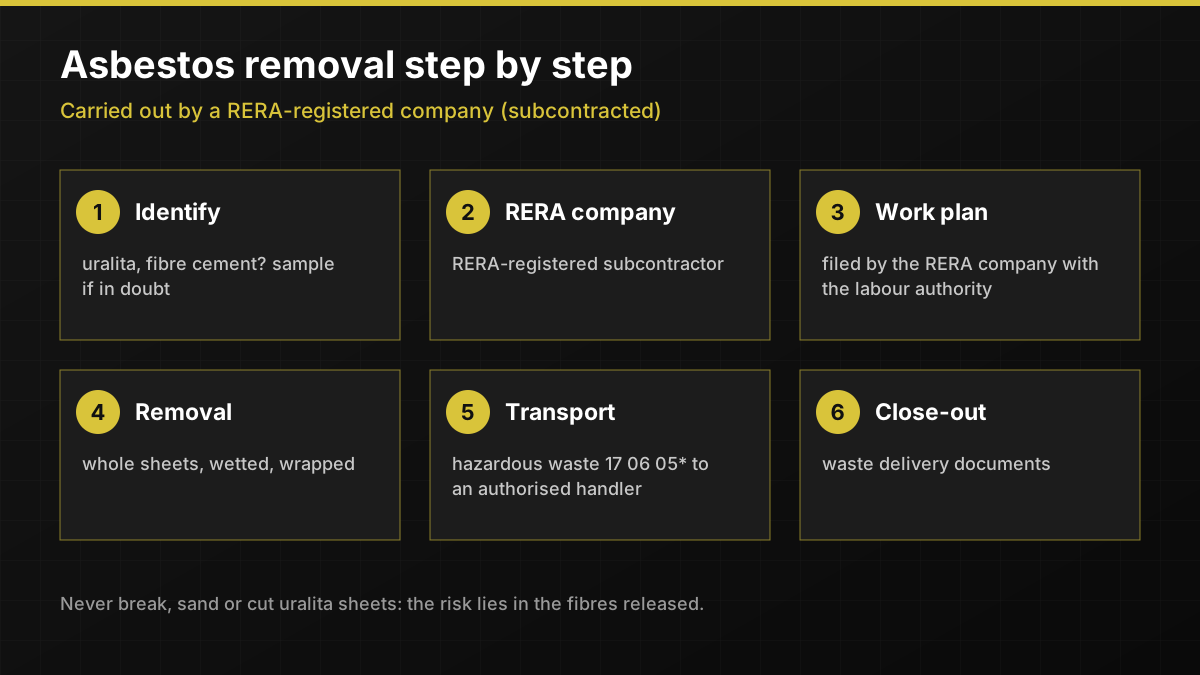
The asbestos removal and the new roof are two different matters. The removal is governed by labour rules – a RERA-registered company under a work plan approved by the provincial labour authority, now under Real Decreto 847/2026. The new roof is a construction work governed by urban-planning rules.
Whether a roof replacement needs a declaración responsable, a licence or another procedure depends on the scope of the works and on the municipality; each ayuntamiento sets the details in its ordinance. Your técnico or roofer should confirm it with the town hall before work starts. In a protected setting or a historic centre, the choice of material and appearance may also be subject to heritage rules, which is another reason to check early.
If a container, crane or scaffolding has to stand in the street during either phase, authorisation for occupying the public road is needed. In a community of owners, works on common roofs need the owners' meeting agreement under Ley 49/1960.
How are the removal and replacement sequenced?
A well-sequenced job usually follows this order:
- Decision on the replacement and, if needed, the técnico's documentation and municipal procedure.
- Asbestos work plan prepared and filed by the RERA-registered company; start of works notified in advance.
- Disconnection of anything attached to the roof: lights, gutters, solar panels, aerials.
- Removal of the uralita by the RERA company, with separate packaging and delivery of the asbestos waste to an authorised manager.
- Dismantling or repair of the structure if needed, and removal of the other waste, sorted by fractions.
- New roof fitted by the roofer, followed by reconnection of gutters, lights and panels.
On our jobs, the asbestos phase is carried out by a RERA-registered company working as our subcontractor; we coordinate it, carry out the demolition and clearing, and agree dates with the roofer or builder you choose for the new roof. See uralita roof removal for residential roofs and asbestos in warehouses for large industrial and agricultural roofs.
Remove and replace, or keep and encapsulate?
Some owners consider leaving the uralita in place and covering or coating it instead. Whether that is sensible depends on the condition of the sheets and on what you plan to do with the building; we compare the two approaches in our post on encapsulating or removing an asbestos roof.
The key practical point is that any later work involving drilling, cutting or taking the old sheets down will still require a RERA-registered company. Encapsulation postpones the decision rather than removing it, which suits some situations and not others.
For an idea of the factors behind the budget of the removal phase – quantity, height, access, type of element and the waste route – see our sister site's asbestos removal cost page. The replacement roof is quoted separately by the roofer.
A checklist for owners managing from abroad
If you are organising the job from another country, these points keep it under control:
- decide on the replacement option before booking the removal;
- get the roofer's quote and availability so dates can be aligned;
- ask your técnico or roofer to confirm the municipal procedure for the new roof;
- arrange a key-holder for access days and for the roofer's measurements;
- agree on photo updates at each stage: before, during removal, open structure, finished roof;
- collect the papers: RERA company, approved work plan, delivery of asbestos waste, receipts for other waste.
You can write to us in English. Send photos of the roof from outside and inside, approximate dimensions, the municipio and a note on what you want instead, and we will explain without obligation how removal and replacement can be coordinated. For more on recognising which roofs are affected, see our guide on what uralita is and how to recognise it.
Sources
Frequently asked questions
What is the most common replacement for an uralita garage roof?
Sandwich panel is a frequent choice for garages and storerooms because it is light and insulated; metal sheet, asbestos-free fibre-cement or tiles are alternatives depending on use and appearance.
Can I put new sheets directly over the old uralita?
Covering or encapsulating is a different approach from replacement; any later work on the old sheets still needs a RERA-registered company. Assess it with your técnico.
Do you install the new roof?
The new roof is fitted by a roofer or builder of your choice. We coordinate the removal phase with them so the building stays open as briefly as possible.
Is the old structure strong enough for tiles?
Not always. Ceramic tiles are heavier than the old sheets, so a técnico or the roofer should check the beams and supports before you choose them.
Does a new roof need a permit?
It depends on the scope of the works and the municipality. Your técnico or roofer confirms with the ayuntamiento which procedure applies.
Can I just demolish the outbuilding instead?
Yes, often. Once the asbestos has been removed by the RERA company, the walls and slab can be demolished and the area cleared.
What happens if it rains between removal and the new roof?
That is why the dates are aligned in advance and temporary protection is planned if needed. Scheduling in a dry period also helps.
Are asbestos-free fibre-cement sheets available?
Yes. Modern fibre-cement is made without asbestos and can keep a similar look to the old roof.
Who removes the gutters and solar panels first?
The installer or roofer disconnects attached elements before the RERA company starts, and reconnects them on the new roof.
Can a community replace a shared uralita roof the same way?
Yes, with the owners' meeting agreement for works on common elements and with the same sequence: RERA removal first, then the new roof.